
CALL FOR PAPERS
Call for Papers: Artistic Research in the Performing Arts in Central and Eastern Europe
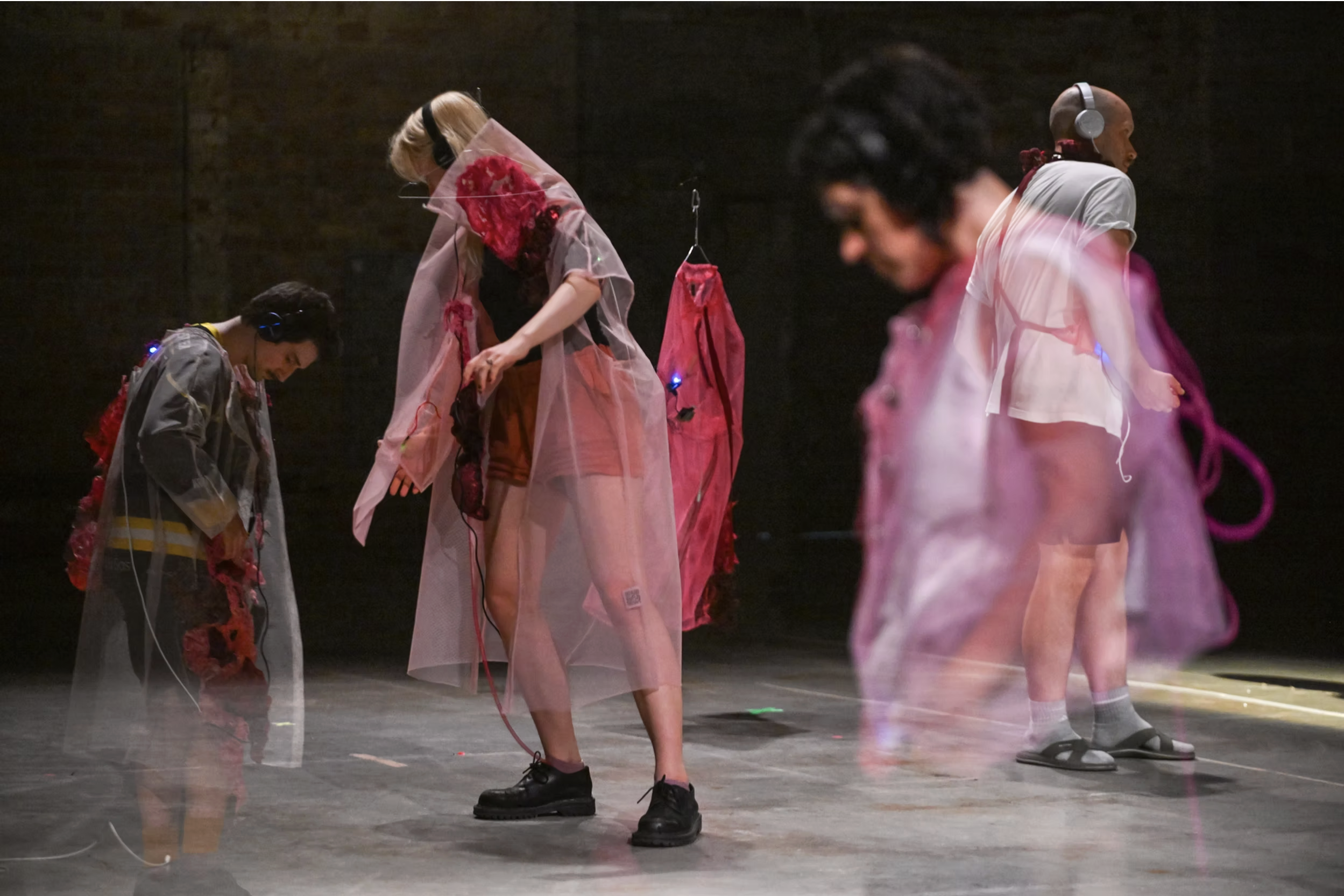
In 2021, a thematic section entitled “RESEARCH-ARTISTIC PRACTICES” was published in Didaskalia. Gazeta Teatralna. The opening article, Riots in Performing Arts Research: a Close-up of Dance, Movement and Choreography, written by the collective Tercet ¿Czy badania artystyczne? (Paulina Brelińska-Garsztka, Zofia Małkowicz-Daszkowska, Zofia Reznik), proposed a dual conceptual framework: on the one hand, a glocal approach to artistic research, and on the other, a perspective rooted in the performing arts.
Today we would like to expand this proposal by broadening the scope of reflection to include Central and Eastern European countries and a range of performative practices extending beyond dance and choreography.
In the above-mentioned article, the collective proposed the following definition of artistic research (AR):
Artistic research is an area of heterogeneous practices situated between science and art as well as other areas of social activity, and its purpose is the production and exchange of knowledge. These practices are the result of connecting – in any combination – social sciences, humanities, the exact and natural sciences, visual and performing arts, music, design, architecture, curatorial practices, socially engaged activities, and even business. A single BA project contains individual proportions of ‘admixtures’ of knowledge, methods, tools, languages, aesthetics and attitudes that are also derived from areas (…). Badania Artystyczne [the name of the Polish tradition of ‘artistic research’] draws on the internationally understood term artistic research (AR) (…), but we perceive it glocally (…) – also in the continuum of experimental traditions of the Polish field of art, including the neo-avant-garde experiments from the 1970s.
This proposal assumed a search for local genealogies of research-artistic practices. We now wish to explore whether and how Central and Eastern European countries—understood as a heterogeneous region including the Visegrád, Baltic, and Balkan countries as well as selected countries of Eastern Europe (Poland, Czechia, Slovakia, Hungary, Romania, Bulgaria, Slovenia, Croatia, Lithuania, Latvia, Estonia, Ukraine, Belarus, Moldova)—have developed distinct genealogies of artistic research, whether similar to one another or entirely original.
The region of Central and Eastern Europe did not participate in shaping the dominant Western discourses of artistic research. Its post-socialist history, different dynamics of transformation, and the specific character of its institutional structures may generate alternative models of relationships between art and science. In many contexts within the region, artistic research still has an uncertain historical, theoretical, and institutional status. Western discourses and support networks—more established and widely recognized—often serve as reference points, and sometimes as aspirations. This situation also carries the risk of an unreflective transfer of theoretical and organizational models that may not correspond to local conditions.
Although artistic research in Poland has gradually received discursive elaboration in the context of visual arts (for instance in publications by the publishing house Bęc Zmiana, including the series Notes na 6 Tygodni and Czas Kultury), performing arts—understood here as practices in which action is primary in relation to the object (e.g. theatre, performance, dance, choreography, socially engaged arts)—remain on the margins both of the self-aware development of this field and of its theoretical elaboration.
The dominance of repertory theatre institutions oriented toward the rapid outcome of a premiere does not favor practices situated between theory and practice. Nevertheless, experimental research-artistic concepts are numerous in the field of performing arts. They develop despite institutional conditions and provide alternative models of artistic creation and audience engagement. Their development, however, requires stable working conditions, time, and an acceptance of the unpredictability of the process. In many contexts (here referring primarily to the Polish situation, without projecting it onto other countries in the region), these practices therefore currently operate under conditions of precarity and institutional marginalization.
Our interest lies at the intersection of two areas that remain overshadowed by dominant narratives: the region of Central and Eastern Europe and the performing arts. Both fields function as peripheral in relation to the stronger models of artistic research and to artistic research in the visual arts. Their intersection allows us to ask questions about alternative genealogies, institutional models, and modes of knowledge production that have not yet been sufficiently described.
To date, no broader publication has attempted to capture this thematic field. The proposed series of texts therefore aims to map the field of artistic research in the performing arts in Central and Eastern Europe, while also strengthening and deepening the discourse around it.
We invite proposals for contributions that:
- attempt to establish the foundations of a theoretical discourse on artistic research in the performing arts in Poland and Central and Eastern Europe;
- map, describe, and analyze existing practices in this field and the ways they are shared;
- enter into critical dialogue with existing discourses around performance as research, performative research, movement research, etc.;
- critically trace potential genealogies of practices at the intersection of performing arts and science in Central and Eastern Europe;
- reflect on the specificity of artistic research in the performing arts in relation to other disciplines (e.g. artistic research in visual arts, social practices, anthropology);
- problematize the institutional, disciplinary, and economic context of practicing artistic research in the performing arts;
- present autoethnographic narratives concerning the practices of researchers conducting artistic research;
- reflect on the role of artistic research in institutional and non-institutional artistic and academic education (at various levels of education, including artistic doctoral programs);
- discuss relations between natural sciences, social sciences, humanities, and artistic practices in artistic research and practice-based research;
- consider the transformative dimension of artistic research—its agency, future, political potential, and possible applications.
We welcome both abstracts for traditional academic articles and proposals for works in non-standard research-artistic formats. Experimental projects will also undergo external academic peer review. In the case of formats requiring non-standard technical solutions, we will consult with the journal’s editorial team regarding the possibilities of implementation.
Please send abstracts of up to 1000 characters or a 2-minute proposal to:
monika.kwasniewska@gmail.com
Timeline
- Submission deadline for proposals: 24 April 2026
- Notification of acceptance: 5 May 2026
- Deadline for full submissions: 30 July 2026
- Expected publication: second half of 2026
Guest editors:
Anna Majewska, Zofia Reznik, Monika Kwaśniewska-Mikuła