
- The Folk Turn in Polish Theatre
- Choreopolitics
- The Failure of the Nonexistent
The Failure of the Nonexistent? A Collectively Managed Feminist Cultural Institution as Exemplified by Teatr Dramatyczny in Warsaw
The collective management of Teatr Dramatyczny in Warsaw – as a feminist cultural institution co-directed by the Dramatyczny Collective – under the leadership of Monika Strzępka was an unprecedented phenomenon in Poland. Based on media reports, supplemented by insights from Iga Dzieciuchowicz’s book Teatr. Rodzina patologiczna, this article explores the reasons behind the project’s failure. The theoretical framework is provided by Thomas Schmidt’s concept of the ‘ethical theatre.’ The author attempts to reconstruct a hypothetical picture of the transformation process within the theatre and the challenges that emerged, highlighting, among other issues, the absence of formal legal status for the Collective, hierarchical management practices, and crisis-driven responses. Both internal and external factors – from resistance to change to media backlash – are considered. While Strzępka’s programme aligned with the principles of an ethical, participatory cultural institution, its implementation diverged from its original ideals. The article also invites reflection on the practical and legislative possibilities for collective management of public theatres.
Keywords: collective management; feminist cultural institutions; ethical theatre; institutional transformation

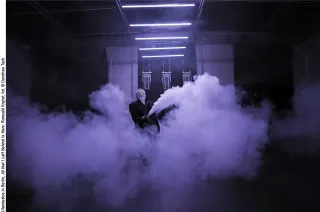
Still from the TV series The Artists, Narodowy Instytut Audiowizualny, Telewizja Polska, dir. Monika Strzępka
Introduction
The collective management of Teatr Dramatyczny in Warsaw1 – as a feminist cultural institution co-managed by the Drama Collective – under the general directorship of Monika Strzępka’s was unprecedented in Poland. Strzępka, a renowned Polish director and recipient of numerous awards, was appointed to this position in September 2022. Her victory was supported by a letter to the theatre’s management, the city authorities, in which she requested that her many years of directing experience be required of the successful candidate for the position: ‘at least five years of experience in managing a theatre company’ (Strzępka, 2021), as well as a bold, overtly feminist programme proposal. Her general directorship began with the performance Sabath dobrego początku (The Sabbath of a Good Beginning), during which Strzępka was crowned with a wreath. At that time, she also introduced the Drama Collective, with which she intended to run the theatre, and provided a breakdown of the tasks and responsibilities assigned to each member. The beginning of her term was disrupted by the political intervention of the Voivode, Konstanty Radziwiłł, who invalidated the order of the Mayor of Warsaw appointing Monika Strzępka as director, resulting in her being suspended for six months, from November 2022 to April 2023 (Kyzioł, 2022). A subsequent favourable court ruling allowed her to return to her position.
After another six months, in December 2023, she dissolved the Drama Collective, assuming sole control. In January 2024 – after a season and a half as general director and, in reality, about ten months active in the position – she was dismissed (Felberg, 2024). Each of these stages was widely commented on in articles of an incredibly wide emotional range: from euphoria to hate. Now, as the excitement gradually subsides,2 it is worth considering the factors that may have contributed to the failure of the project to transform Teatr Dramatyczny in Warsaw into a collectively managed, feminist cultural institution. To do this, I will address the concept of ‘ethical theatre’ proposed by German researcher and practitioner Thomas Schmidt. I will then compare his considerations and postulates with the competition programme of Monika Strzępka and the Drama Collective. Next, based on press reports, I will attempt to reconstruct a hypothetical picture of the transformation process at Teatr Dramatyczny and the problems that emerged during that process. I will consider the extent to which the conflict within the theatre may have been influenced by the resistance to the change typical of a transition period and to a change in the long-established model of directorial theatre. My focus will be on the relationship between the theory and practice of collective, ethical management. By concentrating on this aspect, I will omit many other important aspects of this issue.
This article is based solely on media materials and an excerpt from Iga Dzieciuchowicz’s book, Teatr. Rodzina patologiczna (Theatre. A Dysfunctional Family), based on interviews with various parties to this conflict. It is important to remember that the processes unfolding at Teatr Dramatyczny were influenced by many factors that were either somehow distorted by the media or did not reach the public at all. I also realise that journalistic narratives are influenced in various ways by the interests of specific individuals (the authors and those voicing their opinions), institutions (editorial staff, theatre, city hall), and their shared political and ideological beliefs. While reading the materials on this case, I frequently identified inconsistencies. However, my text does not aim to provide a detailed verification of this archive. Nor do I supplement it with the results of my own ‘field’ research. My use of sources is intended rather to extract information about the theatre’s operational problems and the conflict flashpoints concerning management strategies.
New Management Models
The authors of the report Scena polska 2024. Pracując w teatrze (The Polish Stage 2024. Working in Theatre), summarising a study on the professional situation of theatre employees, point to the dominance of the authoritarian directorship model in Polish theatres, in which ‘key decisions are made mostly by a single person (or in tandem – the general director and artistic director)’ (Ilczuk et al., 2024, p. 106). More horizontal and team-based strategies are currently being tested. The results of these attempts are often negative due to directors lacking ‘the knowledge, competences, and tools to reform the theatre directorship system’ (Ilczuk et al., 2024, p. 113). One of the most important experiments of this type in Poland can be considered the ‘feminist cultural institution’ of the Teatr Powszechny, dedicated to Zygmunt Hübner (Feminisation, Democracy, Labour: Towards a Socialised Cultural Institution, 2020). The documents that were to form the foundation for the transformation of this institution advocated a shift from a hierarchical and authoritarian model based on competitiveness towards empathy, solidarity and equality. This was to be achieved through democratisation, participation and strengthening the subjectivity of the ensemble, as well as the socialisation of the theatre. An important step towards this was the appreciation of both productive and reproductive work. The former is creative and artistic work and is therefore directly linked to the production of performances. The latter, in turn, constitutes part of the institution’s intangible resources, reproducing collective existence. Reproductive work in theatre is therefore performed primarily by those working in the theatre, but not as creators. In a broader sense, incorporating elusive values such as atmosphere, quality of relationships, and communication, it encompasses all employees, including those performing artistic functions. Reproductive labour is the essential foundation of productive work.
A feminist cultural institution, therefore, was about valuing the small, the unspectacular, the everyday, and based on broadly understood relationships, and feminisation meant ‘replacing models of social coexistence associated with a masculine attitude with those associated with a feminine stance’ (Adamiecka-Sitek, Keil, Stokfiszewski, 2020). However, the Teatr Powszechny in Warsaw was led by the traditional directorial duo of Paweł Łysak (artistic director) and Paweł Sztarbowski (deputy director for programming). After several years, Łysak commented with reservations on the ‘feminist’ nature of the theatre he ran as an ideal impossible to fully realise (Chmielewski, 2023, p. 24; e-book). According to Łysak, the implementation of this project is hampered by the collective perception, entrenched by tradition and practice, of the need for centralised authority in the theatre, as well as the provisions of the Act on Organising and Conducting Cultural Activities, which assign all agency and responsibility – legal and financial – to the director. Łysak, therefore, had no illusions about implementing a new directorship and operational model at Teatr Dramatyczny requiring time, which he estimated at ‘at least two seasons’ (ibid.).
A feminist cultural institution, as envisioned in the Teatr Powszechny’s manifesto, is difficult to implement due to its theoretical nature, which still requires a development towards practical solutions. In the case of the theatre under Łysak and Sztarbowski’s direction, the manifesto was accompanied by two documents: the ‘Zasady współpracy twórczyń i twórców z Teatrem Powszechnym im. Zygmunta Hübnera w Warszawie’ (Principles of Cooperation between Artists and the Zygmunt Hübner Teatr Powszechny in Warsaw) and the ‘Rada Artystyczno‑Programowa Teatru Powszechnego im. Zygmunta Hübnera w Warszawie. Regulamin’ (Regulations of the Artistic and Programming Council) (Didaskalia, 2019, p. 5–9). While their pioneering nature cannot be denied, they do represent a contribution to full systemic change, requiring expansion, deepening and practical testing. This form of continuation and verification was also intended to occur at Teatr Dramatyczny, managed by Monika Strzępka and her Drama Collective. Before examining the provisions of Monika Strzępka’s competition programme (co-created by the Drama Collective) and its implementation, I will cite proposals for theatre reform at the managerial and organisational levels developed in Germany, where the reflection and practice on collective directorship and participatory theatre directorship is more developed and systemic than in Poland.
Thomas Schmidt, an academic lecturer with experience as a director, mentioned in the introduction, comprehensively described the problems of managing public theatres and outlined a possible direction for change. His work, which provides a theoretical foundation for thinking about reforming the management of theatre institutions, is firmly rooted in reality, as it is based on a survey completed by 1,966 people representing the theatre industry.
Schmidt’s personal experience and expertise and the broad scope and empirical-theoretical nature of his research make this a pioneering work in the field of theatre. Therefore, although it focuses on German theatre, it has gained international renown thanks to the English-language edition of his book Power and Structure in Theater: Asymmetries of Power (2023). The national nature of his research does not prevent him from outlining recommendations for the transformation of the theatre system that transcend the local context. The researcher calls for a reform of the system, not for developing strategies to operate within the existing one.
Schmidt’s research addresses both violence and abuse of power within institutions and alternative models that would help build an ‘ethical theatre’ in the future (see Schmidt, 2024). Schmidt points out that one of the key causes of abuse of power in German theatres is the omnipotence of the theatre's managing director (seventy-seven percent are men), who single-handedly manages the theatre’s capital, including employment. Schmidt wrote that an authoritarian directorship style combines self-confidence with carelessness and ignorance. However, a sense of omnipotence also comes with assuming a vast number of duties and responsibilities, which in turn stimulates the need for control. He therefore recommends changes in the directorship of theatre institutions (Głowacka, 2022) and proposes two directions: a team- and process-oriented structural reform and a new ethical directorship model (Schmidt, 2023, p. 352).
In his proposed model, based on participation and a balance of power, leaders would serve as knowledge moderators, sharing responsibility with the team and limiting the tools of control (ibid., p. 360-361). To achieve this goal, highly developed emotional intelligence is essential, which should be one of the criteria for selecting a director (ibid., p. 364–366; 393–396). According to Schmidt, the best solution is to abandon single-person directorship in favour of directorial teams in which all members have equal rights. These groups should consist of at least three members but no more than eight, and their size should be adapted to the size of the organisation so as not to hinder a smooth workflow (Schmidt, 2023, p. 381). He advises against illusory solutions in which the management team is led by a director and de facto reports to him. The leadership group should share competences at the artistic, organisational, programmatic, production and management levels but establish an efficient procedure for knowledge flow and make all important decisions jointly (ibid., p. 394). Effective communication with the theatre team and the media is crucial (in this area, team members should represent each other; ibid., p. 345), for which designated individuals should be responsible. Schmidt also advocates for greater gender balance in management positions and cites the example of women’s collectives managing theatres in Zurich. He points out that Theater Neumarkt and Theater Gessnerallee are managed by collectives composed of three women in equal positions, who share roles (in the latter institution) in the areas of dramaturgy, communication and organisation (ibid., p. 394). This state of affairs, with some changes, persists to this day. Theater Neumarkt is currently managed by Hayat Erdoğan, Julia Reichert and Tine Minz, while at Theaterhaus Gessnerallee, Michelle Akanji, Julianne Hahn and Rabei Grand have been succeeded by Kathrin Veser and Miriam Walther, who serve as equal artistic and general directors.3 According to Schmidt, an ethically managed institution should be characterised by, among others: shared responsibility of the management team; the development of strategies and concepts for the future concerning the theatre’s social responsibility; fair (including economically) working conditions; avoidance of corruption and nepotism; focus on education and development in contact with the audience; cooperation with social organisations; and ecology (ibid., p. 358–359).
It is also important to carefully navigate any conflict situations, especially those resulting from changes taking place within the institution, and to use disciplinary and rewarding tools sparingly. He considers it essential to implement codes of conduct, ensure the participation and professional development of the team, and gradually increase the salaries of the lowest-paid – including technical and administrative staff. As Schmidt points out, such a management model is based more on respect and reciprocity than on exerting influence or sanctions (ibid., p. 382–383). A similar restructuring of the theatre system, in his opinion, requires a smooth, long-term transformation of the entire system, encompassing theatres, cultural policy and the media alike. This transformation could take as long as ten or twenty years (ibid., p. 384).
As Aneta Głowacka notes, Schmidt’s research has generated considerable interest in Germany (Głowacka, 2022). At the same time, as Artur Duda emphasises, collective management models also aroused resistance. Duda notes that opposition to new management models in Germany is strengthened by every failure, even partial, in their implementation. He cites examples in which programmes based on democratisation and/or collectivity failed to curb institutional violence, hampered decision-making processes and distracted from artistic work. He draws attention to the ‘double morality’ in which the equality declarations made by theatre managers did not align with their actual practices (Shermin Langhoff at the Maxim Gorki Theatre; Duda, 2022). In the discussion about Monika Strzępka’s directorship of Teatr Dramatyczny, both themes mentioned above – the discrepancy between theory and practice and the abuse of power in collective management – proved crucial. Below, I will examine both the programme that defined the theoretical framework and the complaints concerning management practices presented in the media. By comparing these issues with Schmidt’s proposals, I will highlight hypothetical reasons for this project’s failure.
A Feminist Cultural Institution and ‘Ethical Theatre’
Monika Strzępka’s winning competition programme outlined a project to transform Teatr Dramatyczny into a ‘feminist cultural institution’ that would accommodate the expression of female subjectivity, sexual minorities, identity minorities (LGBTQ+ groups), nationalities and ethnicities, for people of all social classes and ages. A similar inclusiveness was to characterise the theatre’s aesthetic and repertoire. The programme designated a space for contemporary and classical drama, stand-up comedy, female rap and hip-hop, and theatre engaging children and youths. The programme envisioned ‘confronting collective traumas’ and ‘therapy for all’ (Strzępka, Koncepcja programowa). The declarations regarding the theatre’s management were crucial, and they seem consistent with Schmidt’s ideas, as they focused on teamwork and were process-driven. These were included in the programme sections titled In a Safe Process: The Artistic Work System and Organisational Structure. The former described a model of collaboration between the institution and artists. The plan was to open the theatre to diverse models of creative work, according to the principle: ‘less work, more reflection’ (Strzępka, Koncepcja programowa, p. 12).
Emphasis was placed, for example, on the need to support the collective work practised by creative individuals in permanent creative teams, often extending beyond the period of rehearsal and exploration (including in the form of participatory work with communities outside the theatre). The development of a permanent acting ensemble was also envisaged, which the programme called one of the theatre’s ‘greatest potentials’ (ibid.). This approach was intended to counteract violence in the theatre, in line with the belief that ‘stress, (self-)exploitation, and suffering are not necessary for the creation of valuable art,’ and that well-being and safety are the foundation of creative courage (ibid.).
Announced was the practical application of various tools, procedures, and documents developed in the theatre community in response to the #MeToo movement, which sparked a broader discussion in Poland about violence in creative processes. This passage concluded with a strong and rather obvious thesis about the relationship between artistic and social practices (ibid., p. 13).
Similar ideas guided organisational plans aimed at achieving a participatory, ethical cultural institution (ibid., p. 15):
Effective implementation of the organisational and financial plan will be possible with a team of committed and appropriately qualified collaborators – people who have clearly defined areas of responsibility, a precise division of tasks, feel freedom in decision-making, and take responsibility for their areas.
I want cooperation to be based on cooperation, not competition. […] My goal is to move from a strictly hierarchical management style to a model of self-organising teams […]. Such a change should be a smooth transformation, and its pace must stem from an internal process of negotiation, discussion, and maturation for change (ibid., p. 15).
The establishment of a Theatre Council – composed of representatives from all the theatre’s organisational structures – was intended to serve these goals; a Programme-Artistic Council composed of artists collaborating with the institution; and a Programme Team responsible for implementing the artistic and social programme. A key value guiding the work of all these bodies is transparency (ibid., p. 16).
Theory and Practice
The ideas presented in the competition document meet many of Thomas Schmidt’s postulates. In practice, these assumptions were to be further developed, especially in the area of collective management. The programme was signed by Monika Strzępka, and she won the competition for the theatre’s directorship. Strzępka’s programme concept4 makes no mention of collective management, even though – as the artist repeatedly emphasised – it was the collective work of a group that formed a year before which resulted in winning the competition (Romanowska, 2023):
I am very keen to speak of this management in the plural. […] This programme was written with a social energy demanding change. I understood the causative power of community, especially a community of women. I opened myself wide to this experience and understood what it means to live harmoniously and act harmoniously. […] With the girls with whom I wrote the programme, we have developed a very effective and harmonious way of working together. We have common goals – they constitute us as a collective entity (Niedurny, 2022).
The collective authorship of the programme is also evident in its content. The feminist cultural institution is a concept co-created by Agata Adamiecka-Sitek as part of the Porozumienie (The Agreement) project at the Teatr Powszechny. The programme incorporates many procedures, ideas and formulations inspired by those developed in 2019. Monika Dziekan previously served as Natalia Dzieduszycka’s plenipotentiary for organisational development at TR Warszawa, introducing a management model similar to the one described in Strzępka’s programme.5 The extensive theatre pedagogy programme, which encompassed not only the production of performances for children and young people but also close collaboration with these groups, was likely brought to the programme by Dorota Kowalkowska, an experienced and respected theatre educator. Despite this, the names of the women from the Drama Collective do not appear in the competition programme. Apart from sporadic and enigmatic Facebook posts, the first public appearance of the Drama Collective – composed of Agata Adamiecka, Małgorzata Błasińska, Jagoda Dutkiewicz, Monika Dziekan, Dorota Kowalkowska and Monika Strzępka – took place, as far as I know, only after the competition results were announced (in January 2022) but before they took over as directors (September 1, 2022). This was a message for International Theatre Day, delivered on March 27, 2022 (Kobiecy Dramatyczny kolektyw i Monika Strzępka, 2022; Orędzie…, 2022). One might therefore get the impression that the existence and role of the Drama Collective were not explicitly stated until the competition results were announced. Was this due to a fear that the concept of collective management would prove too revolutionary to convince the organiser, or due to internal arrangements within the women’s group, or were there other reasons? It is difficult to determine today. Such an action, however, seems to contradict the idea of transparency, which is essential both in the concept of a feminist cultural institution and ‘ethical theatre,’ and as declared in the programme.
The ceremonial inauguration of the directorship, dubbed The Sabbath of a Good Beginning, could have raised many doubts – both aesthetically6 and due to the act of coronation mentioned in the introduction, suggesting a single-person authority. However, Monika Strzępka then presented the Drama Collective, outlining the division of functions and responsibilities, which was subsequently repeated many times: ‘Dr hab. Agata Adamiecka – plenipotentiary for the institution’s transformation; Monika Dziekan – deputy for organisational and financial affairs; Dorota Kowalkowska, who will head the programming department; and Małgorzata Błasińska, who will be responsible for productions and the Warszawskie Spotkania Teatralne festival organised by Teatr Dramatyczny’ (Mrozek, 2022). At the press conference inaugurating her directorship, she provided similar information and, in a humorous and somewhat risky style, commented on the importance of collective management in a hierarchical structure:
And this simply happens when there is trust. […] I mean, I don't want to live […] in a world based on distrust, on suspicion. That if I don’t read this stack of contracts myself every day, I can’t sign them. But Monika reads them, Agata reads them. I can sign them. […] Ultimately, I'm responsible. I do it consciously. I consciously expose myself, girls [laughter] (Romanowska, 2023).
This division of responsibilities resembled the organisational structure described by Thomas Schmidt. According to Schmidt, collective management is intended not only to prevent the accumulation of power in the hands of a single person but also to evenly distribute responsibility. The researcher argues that managing a theatre is currently a very complex task, requiring a variety of knowledge and skills (Schmidt, 2023, p. 345). At the same time, however, he writes about the division of functions embedded in the theatre’s organisational structure, and no such a phase occurred in the legitimisation of the Drama Collective. As Strzępka stated, ultimately, she was the one who had to sign all the documents and bore full legal responsibility. In this light, the declaration that she would not read some of them sounds downright frivolous. However, this indicates a contradiction between the directorial and collective models.
It is worth noting that Polish law allows for an alternative to a sole directorship by entrusting the directorship of the theatre to a legal entity,7 such as a foundation, association, or company.8 Theoretically, a public theatre could be managed by a team of individuals who together comprise such an organization.9 However, this option is not utilised by public theatre organisers. When a theatre organiser announces a tender for a directorial position, it is already excluding an alternative solution, because the directorship of the theatre to a legal entity is not being bestowed through a private-sector-like recruitment process, but through a public procurement process. However, if the theatre were managed by a legal entity named the Drama Collective, selected through public procurement, the documents could be signed by several designated individuals.10
Time is also an important issue here. It should be noted that the Collective was established a year before winning the competition (Romanowska, 2023). One might wonder whether this is sufficient time to develop a programme and methodology for joint action. Marta Jalowska, a member of the independent collective Teraz Poliż, which has been operating since 2008, argues:
But I am thinking, in the context of Teatr Dramatyczny, where a very specific structure already exists, that the process of preparing for the role of director, or rather the collective managing of an institution that is one of the largest theatres in Poland and located in the very centre of the capital, should take about two years, and overlapping. You have to learn to work with the programme, your immediate team, and all the other professional groups in the theatre, and you should also be paid for it, as in the British model. Systemically, in Poland, such a time is not planned for (Feministycznie, kolektywnie, horyzontalnie – czyli jak?, 2024).
A process inspired by Jalowska’s idea might look like this: a Drama Collective is formed at least a year before the competition. After winning the competition (or tender), it enters the institution for a two-year induction period (time to get to know the institution, prepare new documents and regulations) and, only after that, takes over directorship. The first stage allows the group to form without the pressure of deadlines, documents and accountability, or even mutual – formally determined – obligations and declarations, to, as Bojana Kunst puts it, consider the motivation for working together (2016, p. 74). This is a time to focus on immaterial work ‘utilising communicative and human potential’ (ibid., p. 82). This could then lead to the preliminary development of methods for joint action, including principles of discussion, decision-making, information flow, and action in the face of conflict. In the second stage, a team thus formed could come to understand the institution’s mechanisms thoroughly (including their economic, systemic and customary conditions) and verify whether the previously developed tools are adequate or require any verification. During this time, the collective and the theatre’s employees would have the opportunity to get to know each other better. It is also conceivable that such preparation would provide the future management team with an opportunity to understand the theatre’s financial situation and clarify any unclear, problematic or difficult issues with the city authorities as the organiser. A process spread over several years and stages would allow for a thorough rethinking and verification of the management team’s composition and the division of functions, as well as the identification of competency gaps and their potential remediation.
Iga Dzieciuchowicz’s book, however, indicates that, in the case of the Drama Collective, it was only during the directorship that the initial assumptions in this regard were revised. Monika Strzępka says: ‘I am grateful to the girls for many things. It was a good adventure. However, my conclusion is this: in the theatre, it is better to work with people who know the theatre than with civilians. In my team, it was 50/50’ (Dzieciuchowicz, 2025, p. 290). Two members of the Collective who spoke with Dzieciuchowicz say that, while working with Strzępka, they realised that ‘in some respects, Strzępka truly lacked management skills’ and speculate that ‘she would have been a much better artistic director of the theatre than its general director’ (ibid.). It should be noted, however, that if the process of establishing the Collective and implementing the new directorship had proceeded as described above, Strzępka and the Collective’s term of office would not yet have begun at the time of their dismissal.
Returning from the realm of speculation to the realities of the situation, it is worth noting that not all the people who signed the International Theatre Day Message joined the Collective, whereas Mariusz Guglas (Deputy Director for Technical Affairs) was included in the management team.11 Furthermore, during Monika Strzępka’s directorship, no new work regulations were developed at Teatr Dramatyczny to sanction the assumed division of functions and responsibilities. In response to critical reports,12 in December 2023, Teatr Dramatyczny Directorship (without their names) published a statement admitting that they were still in the process of amending the organisational regulations intended to formalise the division of functions and responsibilities within the Drama Collective.13 A year and a half after the director’s inauguration, there were no documents legitimising the collective management of the theatre. This demonstrates that the organisational changes were not formally prepared at the time of the management’s takeover. This was most likely related to an attempt to develop new regulations as a group, which was also mentioned in the above-mentioned statement.14 However, this does not change the fact that the actual situation did not correspond to the legal situation.
The delay in working on the document may also have been due to Monika Strzępka’s six-month suspension from her position as director, which occurred shortly after her appointment. In November 2022, Voivode Konstanty Radziwiłł invalidated the order appointing Strzępka as director of Teatr Dramatyczny, claiming that her feminist programme did not meet the requirements described in the competition announcement (Cieślak, 2023b). This rationale had all the hallmarks of a backlash. The media reported that Strzępka had been dismissed for her feminism (Mrozek, 2023). This was also a reaction to the director’s performative inauguration, which included the bringing into the theatre of Iwona Demko’s gold-painted sculpture, Moist Lady, resembling both a vagina and the figure of the Virgin Mary (Gazur, 2022). The city authorities suspended the new director from her duties but referred the case to the Administrative Court. From November 2023 to April 2024, when the Provincial Administrative Court overturned the voivode’s ruling, the theatre was officially managed by Monika Dziekan (Kyzioł, 2022). Collective management was then described as a remedy for the crisis. A photo of Monika Strzępka, dressed in gold and hanging on a hook above the stage, appeared on the theatre’s Facebook page, along with the message:
These conditions, although forced, allow for a more complete realisation of our concept of a collectively run institution. The Drama Collective is implementing a new model of theatre management and continuing to implement its winning programme [...]. Is it possible to run a theatre outside the strict managerial mould? Is it possible to manage an institution differently than under single-handed management? Fingers crossed! The direction: a feminist cultural institution. Therapy for all.15
It seems, however, that the Collective, instead of gradually implementing new programmatic assumptions, new procedures, and new management and organisational practices, had to secure the theatre’s operation during a period of crisis, the duration of which was difficult to clearly define, as the situation was unprecedented in Poland. During the ‘suspension,’ Teatr Dramatyczny produced four premieres and prepared another edition of the Warszawskie Spotkania Teatralne. One wonders whether, in such circumstances, production work did not dominate over immaterial, reproductive work and, if so, what alternative scenarios existed.
Teatr Dramatyczny’s problems did not end with the director’s return following a court victory. In an October 2023 interview with Magdalena Rigamonti, Monika Strzępka reported a 1.5 million zloty structural debt that the new management supposedly inherited from the previous one. The artist claimed that she had not been informed of the institution’s actual financial situation, either before or after the directorial competition. In later statements, Aldona Machnowska-Góra, representing the city authorities, defended herself, saying that ‘Monika Strzępka, as someone with no experience in managing cultural institutions, did not know how to exercise her right to inspect the theatre’s financial situation before taking office’ (Dudko, 2023). Another significant problem was the oversized ensemble of actors, which the previous director failed to reduce following the sale of one of the theatre’s stages in 2020. The theatre’s situation, when recognised a few months after taking over as director, prompted Strzępka and the Collective to make savings – including through layoffs.
Although the interview sparked a storm of negative commentary, in Iga Dzieciuchowicz’s book, Monika Strzępka claims that it was initiated by her and the Collective. Guided by the principle of transparency, the theatre’s managers wanted to share the reasons behind their decisions with the public, aimed at rationally managing public funds. They were reportedly satisfied with the interview, but by revealing the secret about the debt, according to Strzępka, they had fallen foul of the city authorities (Dzieciuchowicz, 2025, p. 284–285). From the perspective of collective management and transparency, it is puzzling why only the director participated in the interview, speaking on her own behalf and not mentioning the Drama Collective in her statements. In this context, it is difficult for the reader to determine to what extent her statements actually represented the opinions and attitudes of the other members of the Collective (which would be consistent with Schmidt’s recommendations), and to what extent they were solely her own. And indeed, the first wave of criticism hit Strzępka directly. The situation was only slightly changed by Romanowska’s reportages (Romanowska, 2023a; Romanowska, 2023), which also covered the Collective’s activities. Ultimately, one might get the impression that responsibility for the negatively perceived decisions and actions of the Collective members was attributed solely to Strzępka as the theatre’s director. At this level, therefore, in my opinion, a disconnect arose between collective management and individual representation.
Based on interviews and reports, the management of Teatr Dramatyczny was accused of the dismissals that took place at the beginning of the season (which were legal, but whose timing made it difficult to find work in the season that had already begun), in humiliating circumstances (e.g., a few hours before a performance), with reasons given that questioned professional competences (e.g., lack of so-called performative skills), and showed signs of discrimination on ideological grounds (Strzępka’s repeatedly cited argument that she could not imagine working artistically with people whose value system differed from hers; Rigamonti, 2023). Questionable cost savings were also pointed out: hiring new people to replace those dismissed (balance sheet: 28 actors dismissed, 27 employed; although, as the audit showed, the entire theatre staff was reduced from 144 to 136 people (Wystąpienie pokontrolne, 2024, p. 9), but also: accumulating the responsibilities of both male and female employees; the removal from the repertoire of well-received performances that had been produced under the previous directorship; skimping on hygiene products, coffee and – above all – safety (health and safety) issues. All of this, according to those interviewed by Romanowska, created an unpleasant, tense atmosphere in the theatre.
Romanowska’s reports also devoted considerable space to criticism of the actions of the Drama Collective. In addition to indecisiveness (or an excessively lengthy decision-making process, which negatively impacted time and work hygiene, as well as employee stress levels), the group’s members were accused of poor management, passive-aggressive behaviour, a downwardly critical approach to what had been developed under the previous directorship, and a lack of transparency in the division of responsibilities. According to the people in Romanowska’s reports, collective management did not flatten the hierarchy; it only reinforced it. This fostered increased control within the theatre (exercised not only by the director but also by her team), created a power imbalance during discussions with employees, and potentially blocked complaints regarding the actions of the general director or Collective, as they were supposed to be directed to one of its members, Agata Adamiecka-Sitek, responsible for the institution’s transformation. However, when considering the credibility of these allegations, it is important to consider that they were made largely by individuals no longer working at Teatr Dramatyczny, including those who had been dismissed, and some were anonymous.
The Collective did not respond to some of the allegations, referring primarily to financial matters in a statement issued by management. It cited a series of cost-intensive abuses by individuals who had worked under the previous directorship, which occurred at the theatre, resulting in one person being dismissed for disciplinary reasons, one being given notice of termination and two leaving voluntarily16. The layoffs Strzępka was accused of, therefore, did not concern only the acting team and were not solely based on artistic or ideological considerations. Also pointing to other cost-cutting measures (on coffee, taxis, etc.), the directorship argued that the theatre had been financially mismanaged for years (a subsequent audit, which also covered the final stages of the previous directorship, partially confirmed this thesis17). While it is difficult to reject this argument, it is impossible not to notice that the language of ideas contained in the programme here morphed into the language of economics. However, we do not know who wrote the statement signed by Teatr Dramatyczny management. A division likely arose between Monika Strzępka and the Collective. This is evidenced by Strzępka’s statement from 18 December 2023, in which she reported that she had been blackmailed by several actresses performing in a play she was directing called Heksy in the presence of Collective members. The aim of the blackmail was to persuade Strzępka to sign a resignation from her position as general director (the actresses allegedly said they would not leave for rehearsal until she signed the document). In the same statement, Strzępka dissolved the Collective and announced that from that moment on she was ‘the independent general and artistic director of Teatr Dramatyczny’ (Cieślak, 2023). Ultimately, under the influence of the escalating crisis, Monika Dziekan resigned. Agata Adamiecka-Sitek resigned from her concurrent position as the Student Ombudsman at the Akademia Teatralna in Warsaw (Theatre Academy). In her resignation, she wrote about the failure of the collective management project (Felberg, 2023). The dissolution of the Collective clearly demonstrated Monika Strzępka’s superior position as director. Collective management thus proved to be an idea with very little grounding in reality, either legal or practical. The model of collective management of such a large institution as Teatr Dramatyczny, especially under unfavourable legislative conditions, is unprecedented in Poland, so it would essentially have to be invented from scratch – perhaps inspired by the knowledge developed on this subject in Germany.
At the conceptual level, as I have indicated, the competition programme successfully described a model of a feminist, democratic and participatory institution. The Collective’s lack of adequate preparation for managing such a large and complex theatre, along with the mounting crises, hindered the implementation of changes and the development and practical implementation of a collective management methodology. All of this – as can be inferred from the reports – negatively impacted ethical issues. Ultimately, the collective and ethical management at Teatr Dramatyczny proved to be a sham, as criticised by Schmidt. But can we say it failed if it never truly emerged at the practical level and during a period of relative stability? And can collective management be practised in a hierarchical system?
Resistance to change?
Monika Strzępka’s directorship of Teatr Dramatyczny was not the first failure of attempts to flatten the hierarchy at this institution. Similar efforts were undertaken under Paweł Miśkiewicz’s directorship (2008–12). Dorota Sajewska, then deputy artistic director, reflected on the situation years later:
When Paweł Miśkiewicz and I joined Teatr Dramatyczny, our first move was to swap jobs [...]. We wanted the structure to be more ‘horizontal,’ and it seems to me that work is much more efficient if people can communicate in parallel, horizontally, and not just through the director. It was a rather utopian assumption. I worked in a tailoring workshop for a year, and during that time, no one from the old team treated me as a director. Only when I took over Piotr Cieślak’s room was I noticed and was able to start making decisions, issuing orders and signing documents (Reżyser(ka)..., 2013).
This may indicate that the management model based on traditional hierarchy has become strongly normalised in Poland. Although the accumulation of power can lead to abuse, it provides a sense of security. People who have worked in such relationships for years are familiar with them and know how to navigate them. Changes, even if seemingly accepted, can in practice evoke feelings of discomfort, disorientation, fear and, consequently, resistance. This reaction is understandable and has been described in psychological literature, including in the context of professional organisations (see, e.g., Centkowska, 2015; Wybrańczyk & Szromek, 2018). In the case of such an entrenched management model, as prevailing in Polish public theatres, one can speak of structural inertia, which ‘results from the nature of the organisation as a factor stabilising organisational behaviour’ (Centkowska, 2015, p. 14).
Similar factors may have negatively impacted the restructuring of Teatr Dramatyczny under Strzępka and the Drama Collective. The transformation process was significantly hampered by some employees' fear of renewed destabilisation in the post-pandemic period and by a long-standing conflict within the team, which, in the face of change, divided into those who supported the new management and the Collective, and those who were sceptical. Romanowska’s reports feature individuals from the latter group, most of whom were dismissed after the change in management (see Dzieciuchowicz, 2025). In this context, it is worth noting the opinions cited there, which don’t point to abuses of power but, rather, to the change itself:
But after the season begins, the team quickly realises that – as she puts it – ‘nothing will be the same as before.’ […] It becomes clear to the administrative staff that a ‘feminist cultural institution’ means the theatre is transforming into a cultural centre where the production and operation of performances take a back seat, and various events, workshops, meetings and simple dances become more important (Romanowska, 2023a).
The decision to offer free coffee only in the director’s office – for theatre guests; group mushroom-picking trips; Iwona Demko’s sculpture in the theatre foyer;18 the change of name from gabinet (office) to waginet [a word-play on the Polish for ‘vagina’]; and the fumigation of the theatre with sage also generated resistance. An episode was criticised in which an actor sprained his ankle and the performance was interrupted to send the injured man to the emergency room instead of administering painkillers and splinting his leg to complete the performance. Letters intended to draw the attention of trade unions to the problem in the theatre warned that ‘the creativity of this theatre is being wasted’ and that ‘the theatre of the middle ground should be preserved’ (Romanowska, 2023a). Reports on irregularities at Teatr Dramatyczny are also openly sceptical of the idea of collective management – revealing the resistance to attempts to transform the hierarchical management model, which is very visible in some circles (Romanowska, 2023). They insinuated, for example, that such a model is significantly more expensive than the traditional one, a claim denied in a statement by Teatr Dramatyczny Directorship.
Some of these narratives have a hidden agenda: additional events organised at the theatre caused problems with work hours, and, in the case of the sprained ankle, there was no paramedic in the theatre to treat it and allow the performance to be completed; people who didn’t want to go mushroom-picking felt excluded (Romanowska, 2023a). However, it seems that such issues could have been resolved without escalating the conflict. Thomas Schmidt points out that, during periods of transition, careful conflict-management and the relaxing of critical and disciplinary tools are particularly important (Schmidt, 2023, p. 382–383); it seems to me that these postulates were not implemented here. The resistance, so obvious in a situation of fundamental change, was not mitigated; on the contrary, it gained further reasons to escalate. Magdalena Centkowska, in her text Theoretical Foundations of Resistance to Organisational Change, emphasises that resistance increases the less well-planned the transformation process (2015, p. 11) – and, as media reports suggest, this was the case at Teatr Dramatyczny. Distrust of change is also typically fuelled by a lack of information: ‘about the methods, means, causes, course of implementation, and the purpose of the planned changes; the consequences of the changes for employees in financial, social, and especially material terms; the current and future position of the company; […] numerous misunderstandings in the flow of information’ (ibid.). While, in the case of Teatr Dramatyczny, the direction of change was described at the ideological level in the programme, its actual course was probably not understood by everyone. This was due to the contradiction between assumptions and actions and the lack of new documents formally legitimising the changes. Furthermore, resistance is intensified by increased demands on employees and fear of additional burdens (ibid., p. 12).
In the case analysed here, these included, for example, the expectation of performance acting from the ensemble. Strzępka explained it as the opposite of ‘embodied’ acting, which involves obediently performing directorial tasks. Performance acting, in her opinion, requires the personal engagement of the performer, who is willing to reveal their attitude towards the themes addressed in the performance and does not hide behind stage illusion (Rigamonti, 2023). Strzępka believes that this type of stage presence is based on qualities such as ‘emanation,’ ‘performance’ and ‘improvisation’ (Dzieciuchowicz, 2025, p. 281–282). Although many people mocked Strzępka’s statements on this topic, claiming that all acting is ‘performative,’ this type of acting has a long practical and theoretical tradition – it has been described by esteemed scholars of contemporary theatre such as Philip Auslander (1997) and Erika Fischer-Lichte (2008). The new expectations, however, may have caused confusion, and dismissals based on these expectations may have led to resistance and questions about why the actors were not given the opportunity to acquire such competencies. Resistance is also exacerbated by wounded professional ambition (Centkowska, 2015, p. 11–12), which undoubtedly arose as a result of the criticism of various aspects of the theatre’s operation under Tadeusz Słobodzianek’s managament, directly attacking the competences of those responsible for their implementation (Romanowska, 2023). Another factor is a lack of trust in those implementing the change. The management team, with the exception of Guglas, were not well known at the theatre, as they had not worked there during Tadeusz Słobodzianek’s ten-year directorship. The feeling that the situation was getting out of control (Centkowska, 2015, p. 12), which occurred, for example, during rehearsals for Heksy, directed by Strzępka, also negatively impacted the dynamics of change. This is evidenced by the reaction of actresses who urged Strzępka to sign the letter resignation and then presented sick leave certificates two days before the premiere (Cieślak, 2023), as well as by Michał Sikorski’s statement: ‘In the face of the events that took place during rehearsals in recent days, I felt it was impossible for me to continue working in conditions that deviate from the standards of a healthy, safe process’ (Dróżdż, 2023), and finally Agnieszka Szpila’s statement, who announced that she would not attend the premiere, writing: ‘The enormity of the mental and emotional suffering that the acting team has recently endured is so devastating.’19 As a result, even those initially supportive of the new director or those employed by her withdrew that support.
Techniques for overcoming resistance to change vary, though they primarily involve providing information, engaging employees in the transformation process, and analysing techniques that support it. Above all, however, resistance should not be viewed as a negative factor, but rather as an inherent phenomenon accompanying any transformation in work organisation (Centkowska, 2015, p. 17). At Teatr Dramatyczny, the capacity to avert the crisis and work through the resistance were certainly not increased by the escalating media storm, or even smear campaign, surrounding Monika Strzępka’s directorship.
The Return of the Same
The beginning of Tadeusz Słobodzianek’s leadership, which preceded Monika Strzępka’s resignation, triggered similar institutional mechanisms. In 2013, the press reported that the theatre company was losing a quarter of its cast, and that those dismissed by the new director considered his decisions unfounded and were taking their cases to court. The team appealed to the Warsaw City Hall’s Office of Culture and to the Deputy Mayor of Warsaw for intervention. Słobodzianek was accused of violating workers’ rights, disrespecting theatre employees, creating a hostile atmosphere, exerting pressure and intimidating employees during staff talks. The reason for the dismissal of the actors was that ‘their stage style is unnecessary in the theatre repertoire’ and ‘the directors’ lack of interest in this part of the ensemble’ (Szewczak, 2013). The new director was also blamed for financial losses resulting from the removal of performances produced under the previous management, despite their success. Słobodzianek assured that ‘the procedures for terminating employment contracts were carried out in accordance with the labour code’ and that ‘the process of building a new acting company is a normal phenomenon, especially since my vision for the theatre differs from that of the previous directorship.’ Decisions, including those regarding the repertoire, were driven by necessary cost-cutting measures (Szewczak, 2013). It is hard not to notice the parallels between the accusations against Słobodzianek and those against Strzępka. The arguments dismissing them also seem similar.
What might all this suggest? On the one hand, the similarity of the mechanisms of power and the tools of resistance to change in theatres following a change in directorship. On the other, although the similarities may be only superficial, it is difficult to speak of a radical shift in the approach to institutional management, from the hierarchical and patriarchal model in Słobodzianek’s case to the collective and feminist approach in Strzępka’s practice. The difference, however, is fundamental when we consider the beginning and end of both directorships. Słobodzianek did not win a competition, but was appointed to his position by the city authorities; Strzępka won the competition with a daring programme. These two paths were meant to foreshadow the difference between a director by appointment, who introduced his own order, and a director who made a public promise to introduce a new, more horizontal management style. The failure to fulfil this promise became a significant motive for resistance and a source of loss of trust within the institution and the community. Słobodzianek didn’t disappoint hopes because he didn’t raise them. Despite the resistance and protests from the company, he did not lose his position, as happened with Strzępka, who did not receive a second vote of confidence. This stems, I believe, from the ten years between the two cases, the extensive discussion about violence in the theatre, and the changes in directorial positions prompted by the actors’ protests. All of this changed the sensitivity to the voices of those in weaker positions in the institutional hierarchy and taught them how to respond to complaints about abuse. However, such a rapid loss of trust in Monika Strzępka and her Drama Collective also stemmed, in my opinion, from the avowedly feminist dimension of their programme and the expectation, felt through public discourse, that a change could be implemented immediately, without complications or mistakes. Every stumble, every shift in narrative, every complaint became evidence of failure and the impossibility of introducing new management tools in public theatre. Dorota Glac, a member of the aforementioned feminist theatre collective Teraz Poliż, commented on this atmosphere:
When crises or violence scandals arise in theatres managed by men, they don’t say there’s a problem with patriarchy. It is incredible that in patriarchy you constantly have to prove that it doesn’t actually work, while in the case of a feminist collective, one situation is enough to prove that feminism and non-hierarchy in theatre do not work (Feministycznie, kolektywnie, horyzontalnie – czyli jak?, 2024).
In summary, we can conclude that proven management methods, even if they involve resistance and accusations of violence, do not undermine public trust, because they are what we know and expect. Sajewska and Glac’s statements also reveal the influence of gender issues on the effectiveness of institutional managers. The influence of gender stereotypes on the perception of women in management positions, as described in management literature, confirms these findings (see, e.g., Tomaszewska, 2023). It is therefore difficult not to consider these factors when questioning the reasons for the failure of Teatr Dramatyczny’s transformation.
Conclusion
Monika Strzępka’s competition programme, co-created by the Drama Collective, met many of the hallmarks of an ethical, participatory and balanced cultural institution. However, the actual management of the theatre reproduced, on many levels, the hierarchical model entrenched by tradition and legislation. Teatr Dramatyczny’s operation was not sanctioned, nor was a transparent methodology developed. Instead of empowering the team, developing its competencies and including it in decision-making mechanisms; audits, criticism and dismissals were proposed. The new management also seemed unprepared for resistance, an inevitable factor in any transformation process. At the same time, the circumstances surrounding Monika Strzępka’s suspension, the financial problems, the irregularities uncovered by the new management and the subsequent mounting criticism and even hate meant that the management team continued to operate in crisis mode, most likely losing trust among the team (or at least parts of it), all of which was not conducive to balanced decisions and a slow transformation process.
Translatated by Mark Hoogslag & Tim Brombley
Niniejsza publikacja została sfinansowana ze środków Wydziału Polonistyki w ramach Programu Strategicznego Inicjatywa Doskonałości w Uniwersytecie Jagiellońskim.
This publication was financed by the Faculty of Polish Studies as part of Strategic Programme Excellence Initiative at Jagiellonian University.
A Polish-language version of the article was originally published in Didaskalia. Gazeta Teatralna 2025, nr 186, DOI: 10.34762/0gv8-3a42.