

Choreography as Sites of Encounter at the Norwegian National Company of Contemporary Dance
Artykuł powstał jako odpowiedź na call for papers Choreografia a instytucje. Problemy, diagnozy, studia przypadków pod redakcją Zuzanny Berendt, Alicji Müller i Izabeli Zawadzkiej. Cykl publikowany jest od 189 numeru. / The article was written as a response to the call for papers Choreography and Institutions: Issues, Diagnoses, Case Studies, edited by Zuzanna Berendt, Alicja Müller and Izabela Zawadzka. The series is published from 189 issue.
Abstract
Carte Blanche is Norway’s national company of contemporary dance. This paper investigates what this position means when the notions of ‘national’ and ‘contemporary’ are open to negotiation rather than being navigational coordinates. Using an infrastructural lens that directs our attention to the relation between artworks and frameworks, it explores choreography as a site that implicates local, national and global contexts in an embodied and material encounter. The concept of contact zones and the notion of friction in global connections supplement an analysis of collaborations with three choreographers whose work is rooted in different cultural and geographical situations.
Keywords: infrastructure; national institutions; contact zones; choreography; contemporary dance

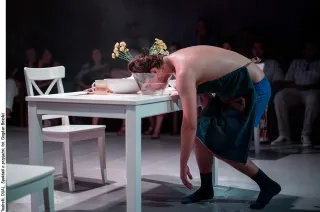
Carte Blanche, Shadows remain silent; photo: Erik Berg
Introduction
Carte Blanche is Norway’s national company of contemporary dance. Since its inception in 19841 as an independent dance company and later as a regional (1989) and then national company (2003),2 Carte Blanche has existed alongside myriad artist-run companies, self-organized collectives and individual artists who share a terrain with porous borders. Once it became formalized as a regional company, it left its roots in jazz dance and gravitated towards modern and then contemporary dance aesthetics (Kvalbein, 2016, pp. 201–6), which in its European and North American genre classification has been predominant in Norway (Fiksdal, 2022, p. 7).
The aim of this article is to investigate what the position of ‘national company of contemporary dance’ means when ‘national’ and ‘contemporary’ are open to negotiation rather than being navigational coordinates. Expansion and diversification in the field of dance sheds new light on how these terms are used to frame institutions and traditions. The question of framing becomes increasingly compelling when we consider that dance as a form of cultural expression has been marginal to the historical development of a national cultural policy in Norway, with its early emphasis on nation building and the public sphere, but gained favour in recent decades as the focus shifted to globalization and diversity (Røyseng, 2016, p. 135–9).
While the institutionalization of Carte Blanche has solidified its position in the dance infrastructure as one of only two national institutions with in-house companies,3 the terrain that surrounds it has expanded and become increasingly divergent. Processes of expansion and diversification have been underpinned by manifold views on choreography, movement, body and place that problematize preconceived aesthetic hierarchies and notions of ‘contemporary’, as well as geographical and cultural delineations (e.g. Fiksdal, 2022; Järvinen, 2021). Efforts to create a heterogeneous and decolonized dance field have made significant strides. Nevertheless, it takes sustained effort to come to terms with blind spots and biases with respect to indigenous Sámi and minoritized communities against the backdrop of colonial history, migration processes and growing diversity. This affects all aspects of society, including the arts (e.g. Ogundipe et al., 2020; Sannhets- og forsoningskommisjonen, 2023; Utsi and Danbolt, 2024).
The article combines an infrastructural lens (Daugaard et al., 2024a; Schmidt et al., 2024; Wilbur, 2020) with the concept of the ‘contact zone’ (Conway, 2011; Pratt, 1991, 2008; Santos, 2005) and the tactile language of ‘friction’, ‘grip’ and ‘sticky materiality’ that Anna Lowenhaupt Tsing (2005) has employed in her discussion of global connections. An infrastructural lens directs our attention to the productive material and immaterial conditions that shape and frame the production and presentation of dance and choreography. ‘Contact zone’ and Tsing’s vocabulary evoke the tensions, negotiations and traces that occur in embodied and material interactions that implicate local, national and global contexts.
I develop the analysis by elucidating the situation of Carte Blanche within the national cultural policy framework and against the backdrop of recent critical perspectives on the term ‘contemporary’ in relation to dance in the Nordic region. To demonstrate how local, national and global contexts are at work in the institutional practices of Carte Blanche, I draw on three collaborations that took place between 2017 and 2023 with choreographers Bouchra Ouizguen, Lia Rodrigues and Elle Sofe Sara. These collaborations foregrounded the idea and act of encounter as Carte Blanche took the unusual step of working with the choreographers at their respective bases in Marrakech, Morocco, Rio de Janeiro, Brazil, and Guovdageaidnu, Sápmi,4 in addition to the dance company’s own premises in the city of Bergen. This decision had implications for the dance productions and how the collaborations were framed and mediated to the audience.
How Carte Blanche perceives and articulates its position as the national company of contemporary dance is a question that is not often asked.5 There is little scholarly research available on the company despite its privileged situation in the national context. Some analyses of dance in the Nordic region include Carte Blanche (Juslin, 2014), as do historical and journalistic accounts of dance history in Norway (e.g. Rørholt et al., 2014; Svendal, 2016; 2024). This article is a contribution towards filling the gap.
Theoretical framework and methodology
To underline the infrastructural dimension of my inquiry, I deliberately refer to the collaboration between the choreographers and the dance company as my research object. More precisely, the focus is on interaction between the contextual situations involved in the collaborations and what this has produced. Although theoretical perspectives on infrastructure emphasize a shift in focus from the artwork itself to the conditions and structures that enable it, the dance productions in this case cannot be left out of the analysis but must be seen as implicated in ‘the flows between production, presentation, and reception’ (Schmidt et al., 2024, p. 21). Furthermore:
This shift does not necessarily diminish the importance of the works presented on the stage, but it presents them as part of larger and smaller processes of life; the infrastructural substructure seeps, so to speak, into the work and out of it, making the lives of both artists, curators, audiences, producers, dramaturges, critics, and production managers oscillate, assembled around the embodied and affective questions posed by artistic pursuits (Schmidt et al., 2024, p. 21).
My concern is with this ‘seepage’ or the interrelation between process and production and how this is framed and mediated. Instead of thinking of performance or the production process as discrete entities to be studied separately, they are both afforded by and intertwined with the productive conditions of the infrastructure. This means that my research materials include the dance productions but also audiovisual, visual and text-based documentation that details, contextualizes and frames the collaborations.
Theoretical perspectives on infrastructure expose how it is often treated as ‘hidden or taken-for-granted entities that sustain forms of life’ (Wilbur, 2020, p. 362). This masks how infrastructures do more than provide support for various functions. Solveig Daugaard, Cecilie Ullerup Schmidt and Frederik Tygstrup at the research centre Art as Forum contend that this near invisibility allows us to underestimate and overlook the underlying patterns and protocols that regulate what the infrastructure affords (2024b, pp. 2–13). It also obscures the ‘embodied doings’ of the bodies and commitments that make infrastructure work (Wilbur, 2020, p. 362).
In decolonial theories of science, ‘infrastructures of knowing’ have been critically assessed along similar lines (Medina and Harding, 2025). Infrastructural resources and arrangements are seen as shaping ‘knowing practices’, while ‘knowing practices also help to reproduce the infrastructures that are embedded in them. […] We need, then, to think of knowledge and practices and their infrastructural resources in the same breath. All of these are done together’ (Østmo et al., 2025, p. 132). This ‘doing together’ underlines the shift from an organizational to a relational understanding of how practices and infrastructural resources continuously shape each other.
While an infrastructural lens provides an overarching perspective on Carte Blanche as an institution, the analysis also draws on the concept of the ‘contact zone’ and the tactile vocabulary of Tsing. As sociologist Janet Conway has explained, ‘contact zone’ has two divergent connotations, one that emphasizes cosmopolitanism and ‘dialogue across difference’ that she associates with sociologist Boaventura de Sousa Santos (2005) and one that emphasizes the legacies of imperialism and colonialism and foregrounds the struggle between asymmetrical relations (Conway, 2011, pp. 219–21). Conway associates the latter with literary scholar Mary Louise Pratt (1991, 2008). The cosmopolitan perspective of Santos might seem more relevant to the mutual agreement to collaborate on an artistic production than Pratt’s conflictual perspective. Nevertheless, in the collaborations I am analysing, geographical and cultural differences, socioeconomic asymmetries and implicit power-laden structures, both historical and current, are at work to varying degrees. Without overemphasising the imperial and colonial contexts that Pratt is referring to, her description of ‘contact’ is instructive:
A ‘contact’ perspective emphasizes how subjects get constituted in and by their relations to each other. It treats the relations among colonizers and colonized, or travelers and ‘travelees’, not in terms of separateness, but in terms of co-presence, interaction, interlocking understandings and practices, and often within radically asymmetrical relations of power’ (2008, p. 8).
The three collaborations I have selected for this analysis have in common that they position embodied experience and the act of encounter as central to the choreography. Instead of attempting to minimize or neutralize difference and possible tensions, they become part of the ‘sticky materiality’ of the collaboration, providing ‘grip’ and ‘friction’ to the endeavour to create together. Chronologically, the first of these collaborations was with the Moroccan choreographer Bouchra Ouizguen, which resulted in Jerada, which premiered in 2017. In 2020, Carte Blanche presented Nororoca, a re-working of the dance production Pororoca that the Brazilian choreographer Lia Rodrigues created together with her company Companhia de Danças in 2009. The most recent of the collaborations was in 2023 with indigenous Sámi choreographer Elle Sofe Sara together with Sámi architect and visual artist Joar Nango. Their collaboration with Carte Blanche resulted in BIRGET; Ways to deal, ways to heal (hereafter BIRGET). Except for Nororoca, of which I have only seen a video-recorded performance in addition to video excerpts of Pororoca that are available online, I saw a live performance of all the productions the year they premiered. I have also had access to video recordings of Jerada, Nororoca and BIRGET.6
Cultural policy and notions of ‘national’ and ‘contemporary’
National cultural policies became part of the foundation of Nordic welfare states in the years following World War II. The ‘Nordic Cultural Model’ was built on democratic ideals and differentiated between arts and culture on one hand and the marketplace on the other (Dueland, 2008). Within the individual states there was also a focus on cultivating a national identity and culture, but as dance scholars Karen Vedel and Petri Hoppu have pointed out, ‘the increasingly diverse configuration of ethnicities and cultures in the Nordic countries has challenged such notions since the latter decades of the twentieth century’ (2014, p. 4). While ideals of artistic freedom and accessibility have continued to underpin the Nordic model, they have also been challenged and supplemented by other logics such as instrumentalizing culture for social and economic objectives and private patronage (Dueland, 2008).
Historically, nation building and establishing a public sphere gave the implementation of a national cultural policy legitimacy in Norway (Røyseng, 2016, pp. 135–6). While visual art, literature and theatre were seen as useful to these objectives, the position of dance was marginal. Reflecting on why, cultural sociologist Sigrid Røyseng has named the role of the body, the predominance of women, and the perceived lack of an intellectual culture around dance as possible reasons (2016, p. 138; cf. Berg, 2016). According to Røyseng, as policy focus turned from nation building to a globalized perspective, the conditions for dance improved. This was also due in large part to coordinated efforts to tie dance’s potential to a lack of infrastructure and use this as an argument to convince politicians and policymakers to support dance (Røyseng, 2016, pp. 138–9). Major initiatives aimed at dance largely occurred after 2000 and included dedicated funding schemes in the Norwegian Cultural Fund, a national stage for Norwegian and international productions, and decentralized regional centres for dance.
Vedel and Hoppu have argued that mobility across national borders and an international outlook have been long-standing factors in the development of dance expressions in the Nordic region, which challenge ideas of territorial nationalism and stability (2014, p. 5, 10). Like other artists and companies in Norway, Carte Blanche has been a part of transnational dance contexts, especially, although not exclusively, in the Nordic region and Europe. Dance scholar Inka Juslin has suggested that Carte Blanche has cultivated ‘a multinational and multicultural discourse’ when performing abroad rather than promoting Norwegian choreographers or a Nordic identity in its aesthetic and choice of subject matter (Juslin, 2014, pp. 160, 170–2). Although what is meant by ‘multicultural’ is unclear, the transnational composition of the company and its repertoire distinguished Carte Blanche from Nordic colleagues in the context Juslin examined. To varying degrees, this has been characteristic of Carte Blanche since its earliest days as an independent company.
The configuration of the company shifts slightly from production to production as dancers depart for various reasons. Since Jerada, Nororoca and BIRGET were created within a span of approximately six years, such changes are to be expected. Most of the dancers who were part of the original casts of these productions have a background from Norway or other European countries. Only a few of the dancers have a background that includes connections outside of Europe.7
By highlighting the background of the dancers, my intention is not to reduce their personal and professional histories and artistic contributions to a single national identity, but to underline that the notion of the national does not reside with them nor with the repertoire. Although Carte Blanche has entertained ideas about cultivating a ‘Norwegian identity within contemporary dance’ (Carte Blanche AS, 2004)8 and apparently even briefly called itself ‘Nordic Dance Theater’ (Rørholt et al., 2014, p. 14), ‘national’ is first and foremost a symbolic, representational status that is conferred through cultural policy.
‘Contemporary’ is the other identity marker in the company name. Choreographer and artistic researcher Ingri Midgard Fiksdal has argued that the increasing diversity of approaches to dance in Norway and the Nordic region has put pressure on implicit aesthetic hierarchies and the definitions of contemporary dance that support them. When these definitions remain unspoken, we might overlook how they underestimate and exclude dance practices with codifications that differ from European and North American traditions of dance art (Fiksdal, 2022; Järvinen, 2021). Instead, Fiksdal has suggested that we should foreground the temporal notion of a shared timeframe in which a variety of practices and expressions unfold. The implication of this critique is that ‘contemporary’ has become a term that is laden with tacit and entangled histories of dance art, colonialism and biases. It emphasizes how practices and understandings become habitual and embedded in structures and ways of doing, e.g. education, modes of production and presentation, and notions of quality and professionalism (Daugaard et al., 2024b, pp. 2–3; Fiksdal, 2022). These are infrastructural concerns.
Making the encounter matter
The critical discussion of implicit hierarchies and definitions of ‘contemporary’, together with the symbolic status of ‘national’, offer a backdrop to the collaborations between Carte Blanche and Ouizguen, Rodrigues, and Sara and Nango. Although the choreographers have strong connections to their respective geographical and cultural situations, they do not work in isolation from the transnational dance circuits in which Carte Blanche also participates. They too have relied on the infrastructures that these circuits provide when producing and performing their own works, as many dance artists do. But they also shape, and are shaped by, other infrastructures that exist concurrently. Consequently, the encounters between these choreographers and Carte Blanche were not limited to the production of a dance piece to be promoted and performed on stages within these circuits. The encounters were the matter of the collaborations. They extended beyond the studio space and the stage and confronted the dance company with conditions and topographies that have informed the situated practices of the choreographers.
Ouizguen, Rodrigues and Sara are deeply involved in creating opportunities in their communities by shaping local infrastructures.9 Ouizguen has been engaged in developing the dance scene in Marrakech in addition to creating works with Compagnie O, where she primarily works with local dancers and musicians. Rodrigues and her company Companhia de Danças work in the socioeconomically disadvantaged favela Maré, where they have been involved in developing centres for education, art and culture since 2004 in partnership with the non-governmental organization Redes de Desenvolvimento da Maré. Rodrigues also founded the dance festival Panorama in Rio de Janeiro. Together with visual artist and writer Máret Ánne Sara, Elle Sofe Sara founded the arts organization Dáiddadállu in Guovdageaidnu, which is based on Sámi principles of solidarity, sustainability and a holistic worldview. Their aim is to strengthen the conditions for art in their local community and throughout Sápmi.
The engagement of these artists in their local infrastructures is in my view inseparable from their artistic practices even when collaborating with Carte Blanche. This is underscored by the fact that the dance company departed from its usual production protocol in which the choreographer travels to Bergen to work with the company. Instead, the company travelled to the choreographers first before continuing the production process in Bergen. Although time was not split equally between the two sites, this was still a significant departure from routine. It altered the relational dynamic and implicit power structure of the collaborations by asking the dancers to immerse themselves in unfamiliar surroundings rather than working solely with a familiar protocol in a familiar space and community. In these collaborations, Carte Blanche traded comfort zones for contact zones and explored alternative formats for dance production by incorporating geographical and cultural contexts that differ from its own.
Places, bodies and choreographies
The extension of the production process across two geographical locations left traces on the performative expressions and how the dance pieces were framed in relation to the public. The significance of place looms large in the mediation as does embodied experience, although in different ways. In Jerada, visual imagery was the dominant form of mediation, which I see as an attempt to capture and share some of the sights, sounds, smells and interactions the dancers experienced in Marrakech. No captions were included to guide our interpretation of the images. Instead, they were shared with the audience together with a collection of texts that dealt broadly with themes of diaspora, regional disparities, freedom, identity and mobility that were peripherally relevant to the dance piece but did not engage directly with it.10 Many of these images, which are photographs taken by some of the dancers and Hooman Sharifi, who at the time was artistic director, have a warm and sensual quality. Others captured social moments that depicted the dancers engaging with local inhabitants or chatting while lounging on cushions at low tables. There were street scenes with colourful buildings and passersby that communicate a sense of immediacy alongside staged images of dancers moving in outdoor locations. The images that stand out to me are ones of local musicians and dancers playing and dancing together with the dancers of Carte Blanche. Some of these images appear to be of performative situations with people sitting along the perimeter of a space observing the performers, while other images give the impression of being taken during a process of creation and rehearsal.

Carte Blanche, Compagnie O, Jerada; photo: Arash Nejad / Nye bilder
The decision to frame the production visually is intriguing but also ambiguous. On the one hand, the visual images created a frame of reference, a site, for an uncompromisingly abstract choreography and musical expression in an unadorned theatre space. The dance production did not attempt to play down the unfamiliarity to ‘Western’ ears and eyes of the rhythms, sounds and movements. The choreography was built on rotations and circular paths and patterns that dancers entered, maintained, transformed and departed from individually, sometimes remaining solo on stage, while at other times forming, merging and splitting into groups of varying size. A slow, methodical rhythmic pattern was established through the sound of voices chanting and the controlled, muted beat of percussive instruments. The subdued quality of the music evoked the sensation that it was emanating from a distance and filtering into the space. The simultaneous evocation of immediacy, continuity and distance established time as cyclical rather than linear. Sensations and impressions of orientation and disorientation overlapped throughout the overwhelmingly kinaesthetic and aural expression of Jerada.
On the other hand, the imagery of the photographs might be seen as, unintentionally, tapping into colonial traditions of exploration and discovery – the power imbalance between the travellers and ‘travelees’ as Pratt (2008) has put it. This interpretation underlines the historical and current geopolitical and socioeconomic asymmetries between Northern Europe and North Africa that the collaboration had to navigate at some level. Still, I see the border-crossing process of meeting and working with local dancers and musicians in Marrakech, which is the focal point of Ouizguen’s work with her own company, as an answer to the question she posed at the outset of the collaboration, ‘how do we survive in a group?’:11
I wanted the dancers to come, see and find inspiration. Experience the light and the sounds of Marrakech and meet the other dancers. Coming to a culture that is not our own became part of the production […]. We have a Moroccan expression: Through travel we get to know each other (Sandvik, 2017).12
By claiming ownership to the invitation to Marrakech and anchoring it in the production process and Moroccan culture, Ouizguen underlined reciprocity and embodied experience as key to the collaboration.
In contrast to the visual impressions used to frame Jerada, Carte Blanche framed Nororoca through textual accounts that recounted the choreographer’s and dancers’ experience of working together, including in Maré. Although the dancers’ text was written by Caroline Eckly, one of the company members, she wrote for the most part from the perspective of the dancers collectively rather than emphasizing her personal experience. Privilege in relation to racial identity, socioeconomic disparities and social instability are central issues throughout the text, which foregrounded the glaring inequality between material conditions in Maré and Bergen that surround, support and shape bodies and dance.
The tone of the text is straightforward rather than emotional. Eckly recounted the experience of staying in a more affluent neighbourhood than the favela and travelling to and from the arts centre where Rodrigues and Companhia de Danças are based. That a group of dancers from a contemporary dance company in Norway came to Rio de Janeiro to work in Maré, surprised many locals according to Eckly:
Indeed, during our stay, we would talk to people from the richer part of the city, in a restaurant for instance, or to the taxi driver, and witness their reactions: they all clearly thought it was strange to work in a favela for a group of foreign white people and all of them added that they never go there themselves (2021, p. 7).
The exchange between Rodrigues, Companhia de Danças and Carte Blanche extended beyond the rehearsal situation to infrastructural concerns. Some of the dancers from Carte Blanche gave classes at the arts centre in Maré, but again the most interesting link in this exchange is place, more specifically the converted warehouse where Rodrigues and Companhia de Danças work. This space, its location in Maré, and the process of renovating it, was the basis for the dance piece Pororoca in 2009, which in turn became the basis for the collaboration with Carte Blanche:
In Maré, there was no theatre, no way to go to the cinema because it’s difficult to go to the rich part of the city when you live there. Lia and her dancers moved to Maré in 2004 and work now in a huge warehouse that was a factory for 20 years which they had to rebuild. […] During the reconstruction of the space, they created Pororoca, the piece that is the starting point for the project with Carte Blanche, and that is extremely connected to this space and this particular moment of rebuilding it (Eckly, 2021, p. 6).

Carte Blanche, Nororoca; photo: Yaniv Cohen
Nororoca continued the original’s exploration of the possibility to gather on common ground and co-exist across difference, as Rodrigues has emphasized: ‘How to build a community on stage? […] How does everyone find their place – always provisional – with their similarities and differences?’ (2021, p. 4). The opening scene of both Pororoca and Nororoca depicts such a scenario. A large group of dancers wearing casual shorts, trousers, leggings and tops in an array of colours gathered at the side of the stage, each holding objects that we might associate with cleaning, mending and unpacking while moving into a new space and exploring a new community. They stood still for a long moment before exploding into motion, tossing and pushing the objects around the space with energy. The objects were allowed to litter the stage floor before the dancers transformed the scene into bodies in flux, supporting, propelling, lifting and manoeuvring other bodies. They crawled, slid, rolled, hopped, collided and clashed, joined and left smaller and larger groups. The temperature of the movement fluctuated between chaos and delicacy, concentrated intensity and tactile sensuality, violence and tenderness, interspersed with shared social moments of rest and practical actions.
The converted warehouse is a physical manifestation of the precarious conditions of living, working and dancing in Maré but equally a manifestation of collective effort and community that has resulted in the arts centre and opportunities for residents in the favela. For Carte Blanche, experiencing the dance space and Maré for themselves was instrumental in transforming Pororoca into Nororoca. ‘Pororoca’ is derived from poro’rog in the indigenous Tupi language, which refers to a powerful tidal phenomenon that occurs when saltwater and freshwater flow together at the mouth of the Amazon River.13 In one presentation of Pororoca, the tidal phenomenon is described as generating ‘waves, invasions, mixtures’ that dramatically impact the composition of the riverbed while maintaining a delicate ecological balance.14 The choreographic and conceptual foundation of the piece in daily life in Maré and the ecological balancing act at the mouth of the Amazon were transformed into an encounter between bodies that live and work in the south and in the north, bodies who have been shaped by and must navigate different realities.
There is however an underlying tension in this transformation that has to do with troubled histories of colonization and the extraction of resources that was not explicitly addressed in the collaboration. Further reading has indicated that the Tupi language was mainly spoken along the Atlantic coast. It was adopted by European colonizers to communicate with indigenous populations and has influenced the Portuguese language that is spoken in Brazil today (Castro e Silva and Hünemeier, 2025).
Ways of knowing
While socioeconomic asymmetries and racialized disparities were tangible in Maré and shaped to a certain extent how the collaboration between Carte Blanche and Rodrigues was framed, they remained largely invisible in the dance production. Perhaps this is because the dancers in effect were taking on a pre-existing choreography that had travelled, even if it was conditioned by first-hand bodily experience of the place and situation that inspired it. In the collaboration with Sara and Nango in 2023, however, the continuation of troubled histories into the present made its sticky presence felt throughout. Histories of daily life and settler colonialism in Sápmi, along with political measures taken by Norwegian authorities to redress injustices, were placed on stage as tangible objects, installations and archival documentation. For Carte Blanche, the collaboration that resulted in BIRGET, ostensibly took place closer to home than the collaborations with Ouizguen in Marrakech and Rodrigues in Rio de Janeiro. But closer to home does not necessarily mean familiar terrain. This contradiction becomes even more pronounced if we consider that most of the original cast of dancers were not originally from Norway themselves.
Sara trained as a choreographer at the Oslo National Academy of the Arts, but her artistic practice is deeply entwined with Sámi culture which is indigenous to Norway, Sweden, Finland and parts of Russia. This cultural territory, collectively known as Sápmi, does not adhere to the borders of nation-states. BIRGET is a Sámi word that means something along the lines of to ‘cope’ or ‘survive’. It can be read in the context of assimilation and displacement policies that Sámi people and other national minorities were subjected to by the Norwegian state, but also in terms of leaving a light footprint and getting by with little.15 The collaboration between the Sámi artists and Carte Blanche took place just prior to the publication of the report by the Truth and Reconciliation Commission (2023) that investigated policies of ‘Norwegianization’ and the injustices they have caused historically but also across generations and into the present day.

Carte Blanche, BIRGET; Ways to deal, ways to heal; photo: Øystein Grutle Haara
As with Jerada and Nororoca, the process of BIRGET started with the company travelling to the choreographer. This time the destination was Guovdageaidnu in Northern Norway, where Sara is based. Visual footage of the dancers walking through the snowy landscape was central to framing this collaboration for the public, as were filmed and written interviews with Sara and Nango. In one of the interviews, Sara explained the significance of walking to experience landscape and culture with the body:
You walk with humbleness, especially when you start or come to a new place. And I do that a lot, also when I create. […] Where we’re going to walk, there is no road. We make our own track. Sámi culture is very important in this work. So it was important for us that the dancers who are going to carry the work, who will embody the work, acquire a bodily understanding of it.16
The embodied practice of knowing through movement was not limited to the sensory exploration of natural or built surroundings but was also a way of entering lived realities. This was transposed to a choreographic strategy that would allow the dancers to carry the stories of Sámi people who have had to cope with losing culture, language and livelihood. In the performance, despite these harsh realities, choreographic elements of walking and running often led to manifestations of community.
BIRGET was also a principle used in sourcing materials to construct the installations that formed the dancers’ unruly environment on stage. Indigenous forms of knowledge inform Nango’s work along with nomadic, shared and social practices in Sámi culture. In line with his approach to mixing modern and traditional materials and techniques, natural and human-made objects related to mundane practices of daily life in Sápmi were gathered during the working period in Guovdageaidnu and used to create the set. The staging of the work incorporated temporalities of pasts and presents into a temporary archival assemblage. The stories that the dancers carried rubbed up against video feeds from Sápmi and archival documents that included official speeches, debates, and formal apologies from the Norwegian state to the Sámi people. Questions of Sámi rights including the right to culture, language and land, and issues of self-governance were transmitted through sound recordings as well as text excerpts that were projected and installed in the performance space.
The nomadic, material and collective dimensions of BIRGET brought an infrastructural premise to bear on the collaboration. Choreography, dance and the assemblage of visual, material and archival elements on stage centred indigenous Sámi knowledge, experiences and stories against an explicitly political backdrop. The tension between Sámi perspectives and official Norwegian policy that the collaboration produced through artistic means was echoed in the institutional framework. The bodies who cared for and carried these histories were a company of dancers with different nationalities working together as the Norwegian national company of contemporary dance. Whether this re-distributes or consolidates power relations lingers as an open question. By asking other bodies to carry these histories, BIRGET brings us, as a public, a little closer to a sense of shared responsibility for dealing and healing as the title of the production indicates.
Conclusion
The question of whether power relations have been re-distributed or consolidated could be asked of all three collaborations. Have they had a transformative impact on Carte Blanche or are they isolated instances of doing things differently? This is difficult to gauge within a relatively short span of time, but I am inclined to see them as isolated instances that nevertheless demonstrate how choreography can perform interventions into practices that are embedded in infrastructure.
The encounters between Carte Blanche and Bouchra Ouizguen, Lia Rodrigues, and Elle Sofe Sara and Joar Nango challenged institutionalized habits. All three collaborations were based on choreographic processes that explicitly required the dancers to immerse themselves in different cultural environments and histories. The collaboration between artists to create and perform a dance production is a temporal event, but it is also a corporeal encounter between bodies, practices and places in the tangible world of social, political and cultural realities. In Tsing’s vocabulary, these realities give grip to the encounters. By conceptualizing choreography as sites of encounter, the collaborations underscore that institutions as infrastructures do not simply support the production and distribution of new dance pieces. They determine the productive conditions and embodied doings that shape production processes and artworks and how they are framed in relation to the public. Employing an infrastructural lens makes these conditions visible, which makes it possible to scrutinize the underlying structures that produce and sustain them. Instead of taking them for granted, we are asked to reflect on what they do.
The encounters between Carte Blanche and the practices of Ouizguen, Rodrigues, Sara and Nango have also challenged the assumption or illusion of institutional neutrality. Even though ‘national’ points to the dance company’s status within cultural policy, and notions of the ‘contemporary’ are renegotiated through processes of pluralization, the collaborations have acted as contact zones where geographical and cultural contexts matter. We are reminded that Carte Blanche is also situated, despite the transnational composition of the company and its repertoire.
Wzór cytowania / How to cite:
Fieldseth, Melanie, Choreography as Sites of Encounter at the Norwegian National Company of Contemporary Dance, „Didaskalia. Gazeta Teatralna” 2025, nr 190, DOI: 10.34762/kma2-tz98.