
- The Folk Turn in Polish Theatre
- Choreopolitics
- The Failure of the Nonexistent
Utopia Embodied: Utopian Impulses in Choreographic Works by Diana Niepce and Agata Siniarska
This work is an attempt to search for and interpret ‘utopian impulses’ in Diana Niepce’s The Other Side of Dance and Agata Siniarska’s null & void, referring to Fredric Jameson’s ‘method of utopia’ and Jill Dolan’s concept of ‘utopian performatives.’ The author examines how bodies present on stage – whether with disabilities or attempting to embody the experiences of non-human beings – can become a space for the temporary realization of an alternative, utopian reality. The analysis of the functioning of individual performers’ bodies is grounded in Erika Fischer-Lichte’s theory of embodiment and Judith Butler’s concept of vulnerability. The theme of interspecies entanglements, within which choreographies are created and utopian impulses are born, is developed based on the posthumanist ideas of Karen Barad and Rosi Braidotti. Finally, based on Randy Martin’s thesis, the political action of experienced performances is reflected upon. The final considerations refer back to the concepts of Jameson and Dolan, emphasizing the possibility of the continuation as well as active influence of utopian impulses and performatives generated on stage and shared within the communal experience of ‘communitas.’
Keywords: Diana Niepce; Agata Siniarska; utopia, subversive embodiment; interspecies relations

Diana Niepce, The Other Side of Dance; photo: Alicja Szulc (Centrum Sztuki Włączającej)
Introduction
1.
The desire for a better world appears to be inherent in human existence. This desire is known as utopia, particularly if it transgresses the boundaries of the real. Etymologically a combination of ‘a good place’ (eutopia) and ‘non-place’ (outopia), the term ‘utopia’ was originally used to describe a literary genre. Utopian writing took issue with the established social system, instead portraying ‘an ideal society, place or state of existence.’ (Oxford English Dictionary). In the early twentieth century, Ernst Bloch offered an alternative understanding of utopia in his book The Spirit of Utopia. Pondering ‘the darkness of the present moment’ (Czajka, 1991, p. 56) becomes the starting point for Bloch’s hermeneutics. The potential of the present day is anticipatory in nature, enabling us to imagine an as-yet-non-existent reality. We are able to overcome any crisis in hand by focusing on the future and attempting to grasp the meaning of existence (cf. Czajka, 1991). This approach was disputed by Frederic Jameson: in his book Utopia as Method, or the Uses of the Future (2011) Jameson describes utopia as genealogy in structural reverse which is not meant to bring us closer to grasping the meaning of existence. Jameson argues that, rather than a thing of the future, utopian bits of reality are barely fulfillable glimpses of alternative experience which can emerge in the present day. For Jameson, an utopia-based analysis is a logical operation:
The operation itself, however, consists in a prodigious effort to change the valences on phenomena that so far exist only in our own present and experimentally to declare positive things that are clearly negative in our own world, to affirm that dystopia is in reality utopia if examined more closely, to isolate specific features in our empirical present so as to read them as components of a different system (Jameson, 2011, p. 42).
Some phenomena – bits of the present as we experience it – call for ‘the detective work of a decipherment and a reading of utopian clues and traces in the landscape of the real’ (p. 26). These clues can take the form of ‘utopian impulses’ whose hermeneutic analysis supersedes any specific description and any attempt to make sense of a self-contained image of alternative reality (see p. 25).
To illustrate his method, Jameson looks into the Wal-Mart phenomenon in the US. Rather than highlight the (unquestionably negative) implications of the dominance of a single company (such as the impact on climate and economic monopoly), Jameson emphasises the positive consequences of the growth of a store network: job creation and making a wider range of products available to people in smaller cities and the countryside, who may not have had easy access to shopping facilities before. In his analysis of Wal-Mart, Jameson puts the utopian fragments to work by focusing on job creation and the democratisation of the market. Having drawn our attention to the positives of Wal-Mart, Jameson goes on to suggest we should reflect on how corporate organisations can be transformed to become more ethical, while remaining beneficial to society (cf. 2011, p. 29–34).
In her book Utopia in Performance. Finding Hope at the Theater (2005), Jill Dolan echoes Frederic Jameson in her search for contemporary traces of utopia. Dolan regards utopia as an ‘approach toward,
a movement beyond set limits into the realm of the not-yet-set’ (p. 7). Dolan analyses selected productions, looking for clues in the form of ‘utopian performatives’ she describes as ‘small but profound moments in which performance calls the attention of the audience in a way that lifts everyone slightly above the present, into a hopeful feeling of what the world might be like’ (p. 7).
The feelings shared by audience members as part of their communitas may transform the audience’s mode of being after the performance has finished (cf. Dolan, 2005, p. 1). Hence the affective form of utopian performatives equipped with the power of active doing (p. 6). The ‘doing’ consists in arousing hope and the desire to recreate this experience in other areas of life. Rather than stage a political revolution, the point is that those taking part in the performance themselves emerge out of it transformed (cf. p. 19). To recognise utopian performatives as affects is to render them distinctly real because the ‘hope and desire (and even fantasies)’ that are part of the common experience ‘are real’ (p. 7).
In my dissertation, I have decided to combine Jameson’s concept of utopia with Dolan’s approach. Both scholars turn to the opportunities (and the hope) potentially emerging from Jameson’s utopian interpretation of impulse and the ‘doing’ of the performative as described by Dolan. The utopian impulse stems precisely from the desire for change and the hope for a better future which may be possible within the established system, even if that system oozes negativity. The performative is an ephemeral glimmer, an illumination, bringing with it the hope that the feeling that emerged while we were experiencing the performance can be transposed to other areas of our lives. Neither the impulse nor the performative are the means to any specific goal; what is more, utopia can never arrive at its definitive form, being as it is of a processual and fragmentary nature. That which is ‘currently negative’ (Jameson, 2011, p. 32) and ‘the most dystopian theatrical universe’ (Dolan, 2005, p. 8) can be utopian in nature. Residues of utopia and dystopian fragments intertwine in all processes and phenomena. This ambivalence and the indeterminate nature of utopia / dystopia, and the fact it is impossible to experience performance as an objective phenomenon will set the tone for my dissertation. I shall avoid unambiguous judgement and analysis; instead, I will reflect on the opportunities, and potential for change, inherent in the experience provided by The Other Side of Dance by Diana Niepce and null & void by Agata Siniarska. My aim will be to demarcate the areas where utopian impulses emerge in the two productions. When interpreting specific choreographic strategies, I shall focus on their subversive potential in particular, demonstrating how on-stage reality may create a favourable environment for generating and developing an utopian impulse, which, through the performative action of audience members, has the potential to further transform reality and shape the future.
2.
Diana Niepce is not only a dancer and choreographer, but also a disabled emancipation activist. In her artistic practices, Niepce seeks to undermine ableist beliefs and scripts which depict disability as a stigma and pity-inducing suffering. When addressing the subject of animals in distress, Agata Siniarska seeks to present non-human beings as something more than subjugated by, and dependent on, humans (though she does admit this objective is impossible to achieve) (cf. Siniarska, 2022). I have decided to discuss the two works together, as they seem to depict different modes of embodying temporary utopias which offer a different perception of reality. What Niepce and Siniarska have in common is their desire to portray a new kind of relationship that emerges between different kinds of materials; their depictions of the entanglement of human and more-than-human beings undermine the established norms and hierarchies which tend to sideline animals and people with disabilities.
The Other Side of Dance premiered in 2022, eight years after a fall from a trapeze left Niepce quadriplegic. Following her accident, Niepce was compelled to redefine her identity. In her post-2014 works – which include This is not my body (2017), Duet[o] (2020), T4 (2020) and Anda, Diana (2021) – Niepce puts the body with a disability centre stage, while using strategies meant to expose the ableist attitudes prevalent in society. Niepce addresses human relationships and the public presence of a non-normative body; she also questions the conventions imposed on dance. Having reflected on relationships and the public presence of a non-normative body, Niepce went on to revise dance archives. The Other Side of Dance may be seen as a manifestation of an individual dance language she arrived at after her accident. The Other Side of Dance was shown in Poland in December 2023, as part of the international Centre for Contemporary Art ‘Pokaż język / Show Us Your Tongue’ programme.
null & void by Agata Siniarska was first presented in August 2023, as part of Berlin’s Tanz im August festival. null & void is another instalment of a series of productions made by Siniarska and her collaborators as part of the ‘Anthropocene Museum’ project, launched in 2022. null & void directly references the war in Ukraine. As Siniarska has stressed, talking to Marcelina Obarska about her inspirations for the production, her aim had been ‘to give voice to those who are denied it in anthropogenic situations’ (2025), and to check whether she was capable of ‘imagining non-human narratives of war or any sort of military intervention’ (2025).
3.
In the opening section of my dissertation, I shall focus on how Siniarska and Niepce’s individual corporealities operate in the productions in hand. I will also highlight areas in which how performers present themselves reveals utopian impulses, and thus demonstrates an innovative approach to the human body. I will reflect on how strategies of embodiment (as described in The Transformative Power of Performance by Erika Fischer-Lichte, 2008) make the restrictions imposed on the body on stage less airtight, making space in which utopian impulses can be set to work.
Although both productions I describe here are solo choreographies, Siniarska and Niepce’s bodies do not exist in a vacuum. Matter is present on stage alongside Siniarska and Niepce’s phenomenal bodies, and the two come together to form an utopian landscape made up of entanglements of different sorts of matter (I shall look at these entanglements in Part II of my dissertation). Although it would seem both productions are anthropocentric in nature, Niepce and Siniarska’s stage presence brings about tiny gaps in the performance’s structure; illuminations highlighting a democratic trans-genre alliance and equality of different types of matter.
Finally, I will attempt to offer a summary of how the on-stage reality of null & void and The Other Side of Dance affects viewers, as it kindles the hope that the world may actually become a different place: audience members are made to feel as if the potential future had already happened. Further growth of utopian performatives is made possible by the political nature of dance, described by Randy Martin as ‘good to think with’ (2011, p. 30) and conveying ‘visions of how we can move together’ (p. 42). I will do this with the help of the following keywords: opportunity, potential and hope. All of these enable the utopian performatives experienced as part of the communitas to spread further, onto other areas of social life (cf. Dolan, 2005, p. 165).
The body in motion
1.
I would like to examine, first, how strategies used by Siniarska and Niepce to present their corporealities contribute to the emergence of utopian impulses. The terms I will be using - ‘body in motion’ and ‘the dancing body’ – are not simply meant to describe the movement of the figure on stage. Instead, they are equivalents of the French phrase corps dansant, used by dance scholar Joanna Szymajda to describe a category comprising ‘a collection of all possible “bodies”’ (2012, p. 27). Perceived in this manner, the body is both the subject and the object of expression (cf. ibid., p.69). It takes the form of a tripartite entity, comprising ‘the system, the image and signifiant’ (p. 65). It would be impossible to discuss Siniarska and Niepce’s performances and view different aspects of the dancing body independently of each other. The unification and merging of the different functions enables many ideas to be embodied at once. As a result, one system may be the source of different utopian impulses, referencing, all at once, Siniarska and Niepce’s individual stories, the issues addressed in their productions, and the state of society at large. Diana Niepce’s stage presence is that of a specific individual, shaping her identity in front of her audience, and in the context of dance history. In broader terms, Niepce defines her place in the world, in that she steps beyond the framework imposed by ableist norms. In null & void, the dancing body becomes an ontological device, used by Agata Siniarska to make sense of her being in the world as members of other species die. (Her performance gives voice to animals who perish in the war.)
In The Transformative Power of Performance, Erika Fischer-Lichte argues that a performer’s phenomenal body (the body that enables them to be in the world) is inextricably linked with their semiotic body which is part of the fictitious layer of representation (cf. 2008, p.95). Niepce and Siniarska exploit the potential of the two aspects coming together: as a result, the affects generated by their performances become more intense, and utopian impulses affect audiences on many levels. Types of embodiment, as described by Fischer-Lichte (cf. 2008, p. 96), are being put to use in The Other Side of Dance and null & void, but without aiming to arrive at any fixed identity. Instead, Niepce and Siniarska use embodiment to portray the process of change and transgression, where questioning the current state of affairs is intertwined with an affirmative approach to a potential future. A change of perspective, from the substantional to the processual, opens up the potential for the emergence of utopia, meant to be a malleable alternative rather than a completed project (cf. Jameson 2011, p. 37).
2.
Diana Niepce deploys the individual strategy of ‘emphasizing and exhibiting the individual performer (-body) [and] highlighting the performer (-body)’s fragility, vulnerability and shortcomings’ (Fischer-Lichte 2008, p. 82). From the very first scene, which has her pulled onto the stage by an assistant performer (who only makes an appearance for the first few seconds), Niepce draws the attention of the audience to her condition and her physicality. The other performer’s departure is followed by a sequence of slow, intermittent movements, as a result of which Niepce turns and lies down on her stomach. By various means (including using her arms), she then lifts her upper body. Her head moves intermittently as she does this: up, down and sideways, as if she wanted to show us the mechanics of her body. A sequence of poses follows: Niepce holds each of them for a few seconds, before sinking back onto the floor, her whole body trembling as she does this. Niepce takes her legs in her hands, thus moving them and causing her body to slide. With her legs set in (reactive) motion, Niepce seems to play with the way society defines disability. If you take a close look at the action on stage, it becomes quite clear Niepce’s limbs are not moving the way they would in a person perceived as normative. Even so, it no longer makes sense to observe motionless limbs to identify disability because these very limbs move and acquire agency as they help shape a choreography. The utopian impulse emerges as the established norms become temporarily disrupted: Niepce’s pose does not conform to the stereotype of how a person with a disability moves and goes about her daily life. Niepce’s sequences comprise common floorwork figures, including a backward roll. This section of the performance concludes with a single gaze which appears to tell the audience they had been looking at the right body in the right place. Niepce freezes in the cobra pose, giving the audience a piercing stare, and thus forcing them to reflect on what they had just witnessed. The body that seemed limp and fragile as it was being pulled on stage, gradually transforms its innate vulnerability (which, incidentally, is part and parcel of Niepce’s daily life).
According to Judith Butler, vulnerability and fragility are, by definition, bound up with being alive: these conditions both structure the being of sentient creatures and determine ways in which they depend on the external. In Butler’s view, injury is one thing that can and does happen to a vulnerable body (cf. Butler, 2009, p. 33–62). In keeping with this definition, the wound (vulnus) may become a source, a crevice from which the utopian impulse emerges. ‘A new, affirmative politics and ethics of accountability’ (Świerkosz, 2018, p. 69) may emerge out of these moments – glimmers of a perspective that diverges from the dominant one. During the floorwork sequences, it is the extraordinary fragility of Niepce’s lower body that enables her to move so seamlessly between poses. The legs become the centre, organising the movement of the other body parts. Although we are aware these body parts do not move of themselves, their role is being subversively reformulated. In this instance, working with the utopian impulse consists in emphasising the agency of Niepce’s reactive legs whose flexibility and weight enable her whole body to move smoothly.
Niepce taking off her T-shirt midway through the performance is a highlight of The Other Side of Dance. Niepce uses her hands to violently hoist herself off the floor, in time with the music. Her head and upper body bounce in time with the energetic beat. Niepce moves forward using nothing but her arms and hands. A smile appears on her face, yet it does not seem to convey positive feelings: it is more likely a response to society’s expectations. Niepce’s facial expression, combined with the tacky background music, places her body within the freak show aesthetics where bodies perceived as ‘other’ and ‘strange’ from an ableist point of view, are deliberately placed centre-stage. The texture of sound becomes more dense, the musical motif becoming curtailed to a mere few sounds which become increasingly similar to industrial noise. Niepce comes to a standstill and begins the process of taking off her T-shirt.
The undressing takes an exceptionally long time. The process starts with Niepce’s assistant re-entering the stage and lifting Niepce (who was lying on her side, and trembling) to a sitting position. This gesture attracts the audience’s attention, in that, having seen the previous section of the performance, they already know Niepce does not need assistance, having repeatedly moved into a sitting position unaided. The assistant’s presence strengthens the impression conveyed by the previous sequences: we are watching a fragile, dependent being, exposed to our inquisitive stares. Moving in bursts, Niepce takes her T-shirt off. Persistent noises and rhythmical shivers can be heard and seen throughout. Niepce stares intently at the piece of clothing she has just taken off. She lifts it triumphantly it with her left hand. The assistant then takes the piece of fabric out of Niepce’s outstretched arm. Niepce holds her pose for a moment longer, as if to give herself, and the audience, time to reflect on what had happened. We are looking at Niepce’s half-naked body: in this sequence, the subversive presentation of the female body consists in deliberately deviating from dominant representations. No attempt is made to emulate the culturally ingrained tropes and formulas for depicting the human figure. With her hand raised in a powerful gesture, Niepce celebrates her presence and being part of reality. She then turns, with her back to the audience, and raises her arm again, exposing her back, with multiple dressed wounds. Once again she raises her arm, this time facing the audience, exposing her bust and never taking her eyes off her raising arm. Here the utopian impulse manifests itself in the belief that, in the circumstances created on stage, the body that does not conform to social norms, is still good enough in its natural form.
3.
As she attempts to take on the vulnerability of animals, Agata Siniarska (who, according to social norms, is a strong individual with agency) herself becomes potentially vulnerable. At the same time, embodying the suffering of animals in her physical form (regarded as able-bodied), makes the non-human beings she references take over some of her strength and agency. What we are seeing is an utopian landscape, where the hierarchy of visibility changes: audience attention is drawn to animals who perish in the war, and yet are absent from the public debate on any war-related subject. Siniarska’s attempt to let the voice of dying more-than-human creatures be heard on stage is in keeping with Butler’s description of vulnerability. According to Butler, The body implies mortality, vulnerability, agency: the skin and the flesh expose us to the gaze of others, but also to touch, and to violence, and bodies put us at risk of becoming the agency and instrument of al these as well’ (Butler, 2004, p. 26).
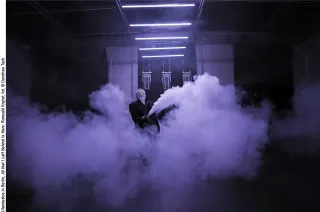
At the start of null & void, we can only surmise it is Agata Siniarska herself hiding under a piece of black fabric. Stage lights are dimmed, revealing nothing but an indistinct outline of the tarpaulin. Both the source of intrusive sounds (which bring suffering to mind) and whatever causes the fabric to pulsate, remain unseen. Even though we may infer that the black mass of fabric covers Siniarska’s figure, and it is Siniarska herself making the blood-chilling sounds, the absence of a discernible human body adds to the uncanny atmosphere. The absence of a visible body, combined with the unsettlingly long time in which the lights remain dimmed, becomes a challenge, bringing the audience together in their shared experience of uncertainty. Subsequent sequences, where persistent music and flashing lights appear alongside the sounds coming from beneath the fabric, further add to the audience’s sense of befuddlement. The fabric moves ever more rapidly. There follows a series of violent scenes, where the sounds from beneath the fabric are combined with overwhelming, loud music. Suddenly, everything comes to a standstill. The music stops, and the fabric is no longer moving. In the stillness, a human elbow emerges slowly from underneath the fabric. The arm rises at right angle to the floor, exposing a peculiar growth on the shoulder. This extended silence, during which a body part is revealed for the first time, does away with the feeling of uncertainty that was so palpable earlier. The utopian impulse, in the form of a human-less performance momentarily becoming real, dissipates.
In further sequences, Siniarska emerges from underneath the fabric, moving in slow motion. She moves on all fours, as if exploring the space around her. Her limbs are stiff and unnaturally bent, her head hangs down between her shoulders. Her face can barely be seen throughout the performance. Although we are looking at one person, the hybrid nature of her figure disrupts the audience’s perception habits in a similar manner to the cross-casting strategy described by Erika Fischer-Lichte (2008, p. 82, 87). The cyborg-like figure makes it difficult to unambiguously determine what sort of character we are looking at. Siniarska’s costume – apparently a collage of the remains of different animal species combined with naked bits of the human body, makes it impossible for clear associations to emerge. Through rapid movements, which come in bursts, Siniarska seems to explore the hybrid figure she is becoming, and the possibility of embodying the experiences of different beings.
The audience begins to share the confusion of this malformed figure. Her movements become increasingly ragged. They bring to mind the shocks caused by the impulses from parts of the body which usually remain inactive during movement, such as the sides of your back. The figure’s quivers and convulsions are attractive and repellent at the same time. On the one hand, it is uncomfortable to try to imagine what the quivers and convulsions must feel like; on the other, it is hard to take one’s eyes off the weird choreography and the face, emerging briefly, when Siniarska raises her head rapidly, her mouth wide open. As she attempts to portray the fragility of dying creatures, Siniarska exposes her human vulnerability. Bathed in a strong pool of cool light, wearing a pale-flesh-coloured suit, she strikes us as a fragile and vulnerable being. This manner of revealing and exposing the body’s fragility is what makes null & void so powerful. The vulnerability of Siniarska’s figure enables the nature of the performance to change rapidly. The convulsions into which she triggers her body seem to hold full sway over her, imitating internal injuries. This is how momentary glimmers emerge, and we are as close as we can possibly get to the convulsing bodies of animals. Siniarska’s flesh-coloured costume enables us to see any micro-impulses in different parts of her body, and the fact she is moving on all fours makes it possible for viewers to feel empathy as they put their imagination to work, trying to grasp what it feels like to exist in the world as a non-human being. To heighten the affect, Siniarska uses the technique of ‘exhibiting the individual performer(-body) […] [and] highlighting the performer(-body)’s fragility’ (cf. Fischer-Lichte, 2008, p. 82). The way Siniarska moves triggers all sorts of automatic responses in her body, including shortness of breath, repeated falls and trembling visibly with the strain of the unorthodox choreography. As they are watching the response of Siniarska’s body to the performance, audience members are able to share the affects emanating from the stage.
The closing sequences of null & void consist in recurrent series of walking on all fours and then sliding into a recumbent position. The body appears relaxed while moving but begins to tremble as soon as it comes to a standstill. Each fall seems definite, but it is only following fall number eight that Siniarska freezes, lying on her side. Her stomach begins to pulsate rapidly. Siniarska lifts her head above the plane of the stage and, by energetically clenching her diaphragm, triggers convulsions reminiscent of the cramps that precede a bout of vomiting. A dark brown liquid, not unlike blood, flows out of her mouth as a terrifying sound is heard: that of Siniarska’s laboured breathing. All the while, her shiny red stare remains fixed on the audience. For the first time, her face can be seen quite clearly. Finally, the liquid stops coming out of her mouth, her eyes close, her convulsions die down. Her body remains still and the lights become dimmed. In the half-light, lit by nothing by a scattered ultraviolet, Siniarska slowly rises to all fours. She turns around and kneels. Her movements become softer, the atmosphere less tense. The figure she portrays raises her back: not in a convulsion, but as if to snuggle up, once again find her feet in the world around her. Her red gaze remains fixed on the audience until the lights go out completely. These scenes subvert the well-known conventions and symbols of suffering. In Siniarska’s performance, suffering becomes a source of power and hope for change. Her repeated falls can be seen as gestures of submission (this is particularly true of the first few instances, when Siniarska raises her arms in a docile gesture). And yet, multiple falls and slight differences in the way she arranges her body can be interpreted as celebrating the endurance of corporeality, and its capability for transgression, symbolically completed after the lights have been fully dimmed.
4.
Vulnerability, repeatedly emphasized in its ambivalent nature, paves the way for an utopian impulse, capable of bringing out any positives in a negative phenomenon. Judith Butler has described a vulnerable body’s mode of existence as ‘coming up against’ (2009, p. 34): a response to the world in which various affects come together. Vulnerability seems an instrument of mobilisation and resistance against the established system, where people with disabilities and non-human beings are pushed to the margins. In this scenario, a celebration of fragility and vulnerability becomes an embodiment of resistance and
a presentation of an alternative utopia, where beings who normally have less agency take centre stage. Both Niepce and Siniarska forge their new identity through movement. The direct and fixed-time nature of their (live) performances, as well as lifting the burden of semiotics, render the characters and situations embodied in The Other Side of Dance and null & void subversive; a potential source of a temporary utopia about to emerge on stage. According to Bojana Kunst, one vital feature of the dancing body is ‘the potentiality of its subversion’ (2019, p. 249). This enables us to forge a relationship with the past which is not so much a story with an ending as a means of connecting with the present: being-in-the-world in the here and now (ibid., p. 249–251).
I would argue that this impulse – the desire to discover ourselves in the world – underlies both null & void and The Other Side of Dance. The dancers’ autonomous bodies enable them to fulfil their inner need, and it is out of this need that the impulse for creating a choreography emerges. Bodily autonomy is an utopia whose scope includes ‘a possible subversion of the body’ (2019, p. 257). Making use of the subversive in Niepce and Siniarska’s bodies not only reveals itself ‘as a specific aesthetic strategy, but as much more: it is a philosophical, aesthetic, social and ideological utopia’ (2019, p. 55).
The way autonomous bodies of the performers are presented in The Other Side of Dance and null & void puts one in mind of the transition ‘from anxiety to affirmation’ (2011, p. 37) as described by Frederic Jameson. Rather than changing the nature of our experience, this transition is about acknowledging its ambivalence, enabling perception to shift from negative to positive.
Bodies in entanglements
1.
When setting out to describe the entanglements in The Other Side of Dance, I have decided to focus on two instances: the opening and the final moments of the performance. It is there that ‘doing’ in relationships with other people makes the greatest impact on the dramaturgy of the show and offers a glimmer of an alternative reality, where people with disabilities enjoy no less agency than the rest of society.

Agata Siniarska, null & void; photo: Pietro Bertora (Santarcangelo Festival 2024)
The on-stage reality created by Diana Niepce is an ‘intra-active field,’ as described by Karen Barad. From this field, different kinds of ‘phenomena’ emerge. The term ‘intra-action’ implies that separate instances with agency do not precede the intra-action between them, but instead emerge out of this intra-action (Barad, 2023, p. 54). Intra-action is the opposite of interaction, which implies the existence of two separate entities (cf. ibid.) In keeping with this definition, we can argue that agency of matter is not born in individual entities; instead, it emerges within a specific phenomenon, or entanglement, whose components are ontologically inseparable (see ibid.) In this kind of relationship, the agency of individual instances becomes purely reactive. In The Other Side of Dance human beings (Niepce and other performers) intra-act with non-human bodies: the hoist and the matter of the stage.
I would like to start by examining the opening scenes of Niepce’s performance. I have already touched on this in Part I, and would now like to analyse it in greater detail. A change in what surrounds Niepce on stage is extremely interesting from a relational point of view. After her assistant has departed, Niepce remains lying on the floor for a while, barely visible in the dimmed light. The silence is complete, except for the sound of various body parts being lifted off the floor and laid down again. This draws our attention to the matter of the stage. There emerges a feeling that the wooden floorboards become partners to the body that rests on them. The sense that action emerges as part of the intra-action with the floor becomes particularly intense when Niepce performs rolls. These dynamic sequences start with an impulse emerging from Niepce’s upper body, as she throws herself onto the floor. She then relaxes, giving in to the skid: the result of her t-shirt coming into contact with the smooth surface of the stage. The relationship between the body and the stage floorboards is not simply interactive: instead, it demonstrates, in a series of fleeting glimmers, how the natural properties of the floor activate their agency in entanglement with other beings. This shows clearly what happens when we become mindful of powers different to ourselves; it also brings about a temporary utopian feeling which enables us to rethink our approach to matter. Becoming open to observing Niepce’s relationship with a different kind of matter; a change in our perception of the floor – noticing its agency – may also translate into a temporary shift in our perception of Niepce and her condition. Rather than focus on diagnosing Niepce and judging her body, we are being encouraged to look at the human body as reactive matter, responding to what other matters ‘do.’
One particularly salient section of The Other Side of Dance are the sequences with the hoist, towards the end of the performance. They show great utopian potential: having taken off her T-shirt, Niepce, who lay still, lifts herself to a seated position. This is a cue for an assistant to come on stage again: she puts Niepce’s hips in a harness and walks away, allowing Niepce to move nearer the hoist herself (before that, the hoist had been towering over her). Two other performers then enter the stage: they operate the hoist, lowering its arms, which support Niepce as she pulls herself up. The assistants then go on to lift the mechanism and stop it when Niepce is upright, with her feet on the ground. Her trembling body seems to stand in the middle of the stage, the sole focus of our attention. In conjunction with other beings and other matters, Niepce finds herself in a pose she would never be able to attain unaided. It seems to me that, by doing so, Niepce shows us an alternative way to achieve the vertical posture: the default option in an ableist world.
As she stands, Niepce beings to gesticulate. She straightens her arms and lifts them, as if to see what will happen to her body when she no longer holds onto the hoist. She then turns her back and falls onto her side. She also contributes to the movement of hoist arms (the arms are being held on the other side by an assistant). After a while, the dependency begins to shift: the assistant is now operating the hoist and Niepce gives in to the movement. When the machinery goes up, causing Niepce’s feet to be lifted off the ground, she straightens her arms and stretches them sideways. She seems to be going along with whatever the structure she is harnessed to does to her body. She deliberately flexes her upper body and lifts her spread arms, her shape now resembling that of the upper part of the hoist. Copying the shape of the machinery may be read as a visual symbol of the connection with another being. Niepce cuts a triumphant figure: she seems to defy gravity and rise above the real world. Trapped in the spread arms of the hoist, Niepce may also bring to mind the Christian tradition of portraying Jesus’ suffering on the cross. This association with religious imagery would seem to imply the impulse we feel exposes as baseless any attempt to make people with disabilities conform to the artificial norm of a human being who moves around on two legs. The utopian impulse makes us temporarily question the beliefs we hold, and encourages us to both feel differently and to question the way we automatically categorise what we see.
Niepce, the hoist and the performer who slowly operates the machinery are inseparable from each other: they are a hybrid, in which entangled instances intra-act. The form of the machinery determines the movements of an organic body, harnessed to the hoist. As she moves, trying to find her balance, Niepce influences the hoist; the hoist, in its turn, becomes a vehicle for an impulse transmitted to the other performer on the ground (and the other way round: from her assistant to Niepce herself). The weight of the machinery itself contributes to the movement that emerges as a result of human effort: the machinery resists, but also reactively responds to the stimuli it receives from both sides.
As she temporarily transforms reality and enables audiences to look at a body with a disability through different eyes, Niepce shows audience members the direction they can travel in once they have left the theatre. The sequences of her solo challenge the perception of the audience, thus encouraging them to pay greater attention to the different matters around them, and to question any automatic categorisations they are being presented with.
2.
In null & void Agata Siniarska explores the entanglements of humans and animals, manifesting as action inside the fabric and the act of ‘fitting’ the human body with organic skeleton fragments. From the very beginning of her performance, Siniarska (and the fabric covering her) work within an intra-active phenomenon. It is difficult to put one’s finger on the source of individual sounds and movement. Siniarska’s activities cannot be perceived independently from the fabric she is enveloped in, and the sound-amplifying microphone placed above the fabric. In the opening sequences of the performance, stage light comes in bursts, revealing matter in three different textures. The part we can see on stage is not unlike black garden foil. This fabric is sewn together with a more elastic layer: this is what covers Siniarska’s body directly, arranging itself into abstract shapes in response to her movements. Attached to this fabric is an intriguing form which brings to mind an outline of a flower cup or a gramophone tube. During the performance, the ‘flower cup’ is mostly turned away from the audience: the fact that it cannot be seen from the front causes disquiet and anxiety. The act of bringing together various objects which cannot be readily identified creates the potential for the utopian impulse to spread; in this instance, the impulse takes the form of a genuine sense of diverse matters coming together. Both the movements and the sounds coming from the stage are not simply the result of Siniarska’s actions: instead, they emerge out of the entire hybrid entanglement. The undulating movement of the whole amalgam is largely the result of subsequent fragments of fabric reactively affecting each other – and Siniarska, hiding underneath. When it comes to sounds, it is a similar story. Once the opening sequences (with Siniarska curled up under the fabric) have been completed, a microphone emerges, dispelling any doubt as to where the sounds have been coming from so far. The cries and hums we had heard earlier where clearly audible thanks to technological support: combined with the rustling fabric and the noises made by Siniarska herself, technology forms a soundscape. Due to the fact that both Siniarska herself and the microphone are enveloped in fabric, at a visual level, the performance is a symbolic representation the primeval nature of the phenomenon (which in this instance takes the form of a hybrid figure made up of Siniarska and all kinds of matter which are there on stage with her). It is within this phenomenon that action becomes possible.
As the performance goes on, entanglements with other beings manifest themselves at the level of imagination. These imagined relationships embody the idea of the post-human condition, as described by Rosi Braidotti. In her book The Posthuman, Braidotti describes the subject as ‘a transversal inter-connection or an ‘assemblage’ of human and non-human actors’ (2013, p. 45). Consequently, any attempt to know and understand ourselves is the result of the process of facing other beings and striving to embody the post-human condition. The post-human condition is focused on zoe: the vital force that runs across species; it also enables us to reflect on existence within a larger whole. The incessant flow of energy and the volatility that is at the heart of existence enable us to search for affirmative, zoe-egatilarian alternatives. The point of zoe-egalitarianism is not simply to elevate animals, or to anthropomorphise them; what zoe-egalitarianism is actually about is recognising common traits in different beings, which enables us to come a step closer to aligning our positions and making sense of them (cf. p. 71). By aligning our positions, I mean a shift in the way we rate the qualities that distinguish human from non-human beings, and elevating the status of any shared characteristics. The point is to become aware of a vital interconnection. ‘This vital interconnection posits a qualitative shift of the relationship away from species-ism and towards an ethical appreciation of what bodies (human, animal, others) can do’ (ibid., p. 71–72). I would argue it is this approach to post-human condition, based on interconnection, that Siniarska presents on stage. She deliberately forgoes the agency that comes with her privileged position. She does this by changing the nature of her movement and making symbolic room for other beings. Needless to say, this shift in hierarchy and Siniarska putting herself in a less advantageous position only occur at an imaginary level. Yet it is precisely in this imagined change that the potential of utopian impulses lies: it is through these impulses that we move a step closer to empathy towards animals suffering in the war. As we focus on the process of facing other beings, we are at least able to come a step closer to a symbiotic relationship with our surroundings, and to produce utopian crevices, where currently established divisions into humans and other species break down.
Embodying potential directions of travel for the future
1.
By means of the feedback loop, as described by Erika Fischer-Lichte (cf. 2008, p. 137–164), the impulses generated on stage can make their way to viewers and have the potential of developing further in other spheres of their lives. In the present chapter, I will be focusing on instances in Niepce and Siniarska’s performances where utopian performatives emerge as part of the communitas between performers and their audience. ‘Utopian performatives appear in many ways within, across, and among constantly morphing spectating communities, publics that reconstitute themselves anew for each performance’ (Dolan, 2005, p. 17). Thanks to the practices described above, audiences can participate (both directly and indirectly) in whatever is being embodied on stage. Thus emerges a shared experience of reality in which the established hierarchies and stereotypes become distorted.
2.
In The Other Side of Dance, Niepce’s interaction with her audience is based on a stare game of sorts. Niepce makes subversive use of the staring mechanisms, as described by Rosemarie Garland-Thomson:
staring starkly registers the perception of strangeness and endows it with meaning. Staring witnesses an intrusive interest on the part of the starer and thrusts uneasy attention on the object of the stare. At once transgressive and intimate, staring breaches the conventionalized anonymity governing visual relations among strangers in modernity (2005, p. 30–31).
Garland-Thomson goes on to argue that staring is ‘the dominant mode of looking at disability in this culture’ (p. 31). It is also a habit, and it ‘constitutes disability identity by visually articulating the subject positions of “disabled” and “able-bodied”’ (ibid.).
In her choreography, Niepce works with the social perception of disability and its connotations, transforming the act of staring into a subversive gesture. First, the very choice of putting one’s body with a disability on stage entails being exposed to stares that define, describe and judge. Due to the fact that no words are used throughout the performance, and music can only be heard in the background, watching The Other Side of Dance is mostly about visual perception. The audience takes in the movement on stage and interprets the performance on that basis: eyesight becomes the main means of reception, while constituting a crucial part of the choreography itself. Moments of intense eye contact are a recurrent theme in the performance, with Niepce staring directly at her audience, confronting her gaze with theirs. An exchange of gazes occurs and evolves during utopian performatives. In these instances, a change occurs in the nature of visual interaction, as the social burden of staring at signs of a disability is momentarily lifted. Niepce takes control of the situation: she gets to decide what her audience are going to look at, while forcing them to confront her as she stares at them, directly and intensely. Thus Niepce demonstrates the reciprocal nature of the stare and makes it abundantly clear to us this is what she has to deal with on a daily basis. She is now the curator of the situation. She is on stage, deliberately risking stares from her audience, and the confrontation this entails. As she moves her gaze from one audience member to another, Niepce seems to analyse them with her eyes, just as, in their day-to-day lives, able-bodied people identify the noticeable symptoms of a disability. There is something paradoxical about this situation: due to stage lighting, it is in fact impossible for Niepce to see the faces of her audience members. Therefore, her gesture becomes symbolic: perhaps of the deficient and senseless nature of the world where people with a disability are described primarily in visual terms, and eyesight becomes an instrument of social diagnoses. The intensity of Niepce’s stare provokes her audience to confront their own beliefs and the stereotypes deeply rooted in their subconscious. These beliefs and stereotypes are being temporarily questioned as part of the performative, shared within the communitas.
3.
The strategies by which audiences are drawn into null & void are twofold. On the one hand, Siniarska’s activity [actions] on stage are abstract in nature. They rely on the imagination of the audience and encourage them to empathise with Siniarska while she is on stage. This is neither a finite nor a definite process: it is based on subtle impulses, moments where audience members feel they have formed a relationship with others. Indeterminacy has the potential of the imagination about it: in her book Utopia in Performance, Jill Dolan describes imagination as an instrument granting us access to an alternative understanding of reality, and enabling us to focus on what we have in common (cf. 2005, p. 163–165). Dolan describes performances where performers tell the stories of members of disadvantaged communities: they do so with a view to including these individuals into society (cf. ibid.). These strategies enable audience members to focus on shared experiences which still exist: not despite, but because of the differences that constitute the human condition. In addition, the strategies patently demonstrate the absurdity of dividing communities into ‘us’ and ‘them’ (cf. ibid.)
In Agata Siniarska’s performance, rather than humanity, the common feature may be zoe, the vital force described by Rosi Braidotti (2013). Siniarska’s purpose in focusing on the vital force shared by all human and non-human species is to find common ground, based on the indelible differences between species – Siniarska is keen not to turn a blind eye to these differences.
Halfway through Siniarska’s choreography, the light shifts decisively from the stage to the audience, keeping us mindful of the hierarchy which is as uneven as it is rigid; and of the fact that animals die in the war because of human decisions and actions. The audience is ‘assaulted’ with a powerful stream of light and thus ‘infected’ with the affects emanating from the stage. This only lasts a few seconds: still, it becomes impossible to distance oneself from the subject of the performance and dismiss the structural inequality in inter-species relationships. The act of turning the stage light to the audience compels audience members to reflect on their position in light of the experience of becoming-an-animal which is being embodied on stage. As we experience an utopian performative together, we may come a step closer to really comprehending how we relate to other beings. While inequality is obviously impossible to eradicate, the utopian performative enables us to temporarily reorient ourselves, taking a step closer towards the existence of animals in our imagination, and to reflect on where we stand in relation to them.
Conclusion
The Other Side of Dance by Diana Niepce and null & void by Agata Siniarska generate utopian impulses which, although ephemeral, have real transformative power. Both Niepce and Siniarska deploy strategies which – in keeping with Jameson’s hermeneutics of utopia and Dolan’s concept of the utopian performative – destabilise the established norms of perception and automatic, instinctive identification, and try to put a finger on a sense of an alternative perception of reality. Niepce and Siniarska use the opportunities provided by the autonomy of the dancing body to create potential communities of human and non-human matter.
Niepce and Siniarska demonstrate that dance has got political potential, as described by Randy Martin. In his essay ‘Between Intervention and Utopia,’ he argues that ‘dance is good to think with’ (p. 30) and immediately enables us to realise a better, alternative vision of reality.
Dance […] makes its own politics, crafts its own pathways and agency in the world, moves us toward what we imagine to be possible and desirable. […] It gathers its public then disperses them suddenly, leaving a sensible residue of what has been and what can only be desired, namely the will to create more (p. 29).
Niepce and Siniarska’s artistic practices make an impact on the possible perception of the human body, other beings and relations between species. A temporary change in the nature of our sensory perception is what makes their choreographies political. Through this political act, what is usually sidelined – people with disabilities, the stories of animals in war – temporarily takes centre stage. As both Jameson and Dolan demonstrate, it is from ephemeral breakthroughs like these that a different future could emerge.
Although The Other Side of Dance and null & void are quite different from a formal point of view, they share an affective intensity and a subversive potential. I have endeavoured to show instances where the distortion of our established perception of the body and its agency is particularly striking. These ephemeral moments of transformation do not constitute a systemic revolution; instead, in Frederic Jameson’s formulation, they amount to an ‘imagination of possible and alternate futures’ (2011, p. 42).
A temporary ‘utopian transfiguration’ (p. 39) gives us hope that further transformation will be made possible through a shared aesthetic / affective experience. This transfiguration opens up the space in which, in Dolan’s formulation, it becomes possible to ‘enact the affective possibilities of “doings” that gesture towards a much better word’ (2005, p. 6). This occurs through drawing our attention to the traces of a better future in the present and offering another perspective on experiencing the reality we are all part of. Niepce and Siniarska’s performances not only reveal new opportunities in the physical and the relational, but also contribute to redefining the community in its aesthetic and political aspect. The utopian impulses flashing on stage affect the perception of audience members and thus can spread to other spheres of social life. As the experiences of The Other Side of Dance and null & void demonstrate, the world as we know it is not the only one that is possible.
Translated by Joanna Przasnyska-Błachnio
The article is based on a bachelor’s thesis written at the Jagiellonian University’s Department of Theatre Studies; the thesis supervisor was Prof. Grzegorz Niziołek.
Niniejsza publikacja została sfinansowana ze środków Wydziału Polonistyki w ramach Programu Strategicznego Inicjatywa Doskonałości w Uniwersytecie Jagiellońskim.
This publication was financed by the Faculty of Polish Studies as part of Strategic Programme Excellence Initiative at Jagiellonian University.
A Polish-language version of the article was originally published in Didaskalia. Gazeta Teatralna 2025, nr 190, DOI: 10.34762/eghg-hs05.